Chained Beasts Animal Types: Roster and Roles
Learn what Chained Beasts animal types do in the arena, which beasts are confirmed, and how variants change shields, speed, and damage.
Picking the wrong fighter can wreck a run before the first boss even shows up. In a gladiator roguelike where stamina, shields, wounds, and a shared chain all compete for attention, Chained Beasts animal types decide how much punishment you can absorb and how you reposition. That choice matters because Chained Beasts animal types are not cosmetic skins: each beast changes durability, damage, and how you spend stamina while you stay chained to your allies.
On Featherweight Games' official Chained Beasts page, the studio describes arena fights built around thrown weapons, environmental kills, injuries that linger, and co-op chains that can trip a rival or wrap your group around a pillar. A sturdy starter and a low-health damage dealer do not fail those problems in the same way.
Why Your Beast Choice Sets the Run
Most of the pressure in a run is not a single number. Health, shield uptime, dodge cost, and how far the chain yanks you all stack. Choose a beast that only wins when you play perfectly, then add a limp or a vision penalty, and the next arena day gets much shorter.
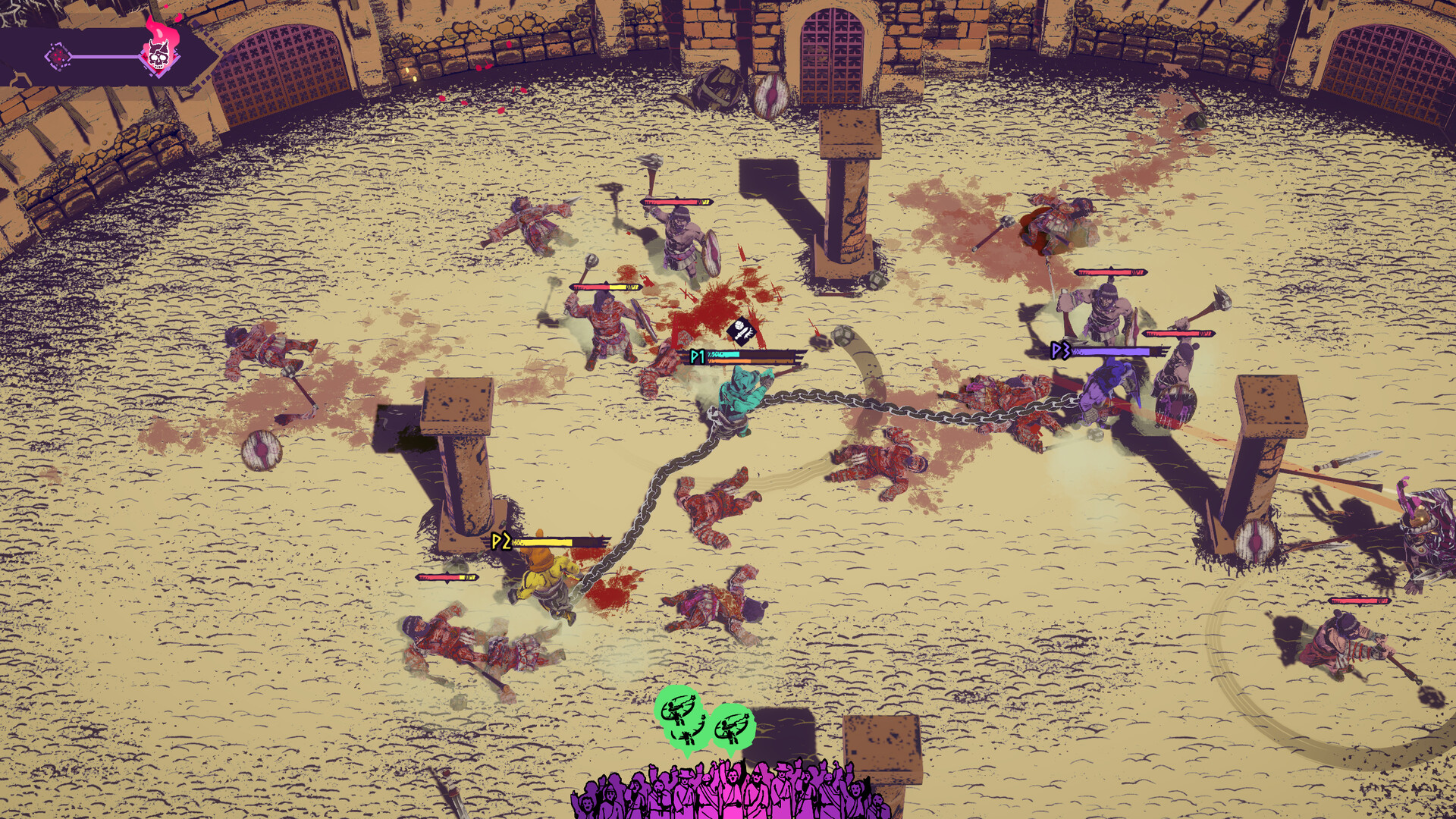
Official screenshot · Source: Steam store
The developer’s pitch is useful context. Rising fame pulls you toward harsher bosses. Potions can trade one affliction for another, and surgery is hinted at as a risky fix. Skills, crowd favor, and bought gear can swing a fight, but none of that erases a bad match between your beast and the wounds you already carry.
| Pressure on the run | What a beast choice changes |
|---|---|
| Blocking and chip damage | How long a shield lasts and how much health remains after a mistake |
| Stamina economy | Whether dodges and chain repositioning stay affordable |
| Time to kill | How quickly a fight ends before a weapon breaks |
| Co-op spacing | How safely you can be dragged toward an ally’s target |
| Lasting injuries | How punishing a limp, a missing eye, or hallucinations feel |
Use that table as a filter, not a scoreboard. Two players can pick the same animal and still feel different once armor, weapons, and the variant text are applied. The character screen appears to keep the animal separate from armor, color, and other presentation options, so the beast is only one layer of the gladiator you bring into the arena.
The Eight Beasts Named So Far
Public roster info comes from two places, and they do not prove the same things. Gameplay footage discussed by players shows six animals. A published PS5 trophy list names eight through winning-run trophies. Those trophy names are a useful checklist. They do not confirm health values, variant bonuses, or how a beast unlocks on every platform.
Use the roster below as a working map of Chained Beasts animal types, not as a final tier list. If an in-game description disagrees with a video or a trophy name, trust the card on your screen.
| Animal | Where it shows up | What you can responsibly say |
|---|---|---|
| Armored rhino | Available early in gameplay footage | Defensive beast tied to a strong shield |
| Agile wild goat / Ibex | Early in footage; listed as Ibex on PS5 | Faster movement and cheaper dodges in that footage |
| Wolf | Unlocks later in the same footage | Described as fierce; full numbers not shown |
| Panther | Unlocks later in the same footage | Higher damage and lower health |
| Bear | Appears on the roster after progress | Called large and powerful; kit unconfirmed |
| Eagle | Appears on the roster after progress | Called deadly; specialty unconfirmed |
| Lion | Named on the PS5 trophy list | Winning-run trophy only; stats unknown here |
| Monkey | Named on the PS5 trophy list | Winning-run trophy only; stats unknown here |
Early footage highlights two starters: the armored rhino and the agile wild goat. Later roster shots add wolf, panther, bear, and eagle. Lion and monkey are the gap. They are named, but this guide cannot assign them a playstyle without inventing one.
What Each Known Animal Seems to Do
Public footage of Chained Beasts animal types is clearest on the two starters and the panther. Everyone else is a name with a short description. Treat the notes below as player experience from gameplay footage, then reread the beast card before a serious run.
Armored rhino
The rhino is the defensive starter the footage actually demonstrates. One variant keeps its shield up for twice as long and cuts incoming damage by 30 percent. That is the most specific defensive figure available right now, and it belongs to a variant, not to every rhino build automatically.
New players get the most from that cushion while they learn enemy tells, block timing, and stamina. In co-op, the extra protection also helps when a chained ally drags you into a swing. It is not a free win. Shields can still break, and heavy gear can slow you, so you still need an exit when the guard fails.
Agile wild goat
The wild goat, named Ibex on the PS5 list, is the mobility starter. A shown variant moves faster and spends less stamina on dodges. Stamina also pays for evasive steps and for shifting along the chain, so cheaper dodges leave more in the tank. Quicker feet help you circle a large enemy, leave an area attack, or back off when a thrown weapon does not come back and you are suddenly unarmed.
Players who would rather avoid hits than absorb them should start here. The footage does not give the goat the rhino’s documented shield bonus, so the timing has to be cleaner. Miss the dodge, and you do not have the same published safety net.
Wolf, bear, and eagle
In the footage, the wolf unlocks after a successful stretch through Carthage. The description calls it fierce, without a full breakdown of health, damage, stamina, or variants. Do not assume it is simply a stronger goat or a faster rhino.
The bear shows up as a large, powerful beast. The eagle is labeled deadly. Neither line is a build guide. Nothing in the footage proves the bear has the biggest health pool, and nothing proves the eagle specializes in speed, ranged hits, or criticals. Some choices in the game trade health for speed, so a bulky portrait is not a stat sheet. Unlock them, read the variant lines, and try a lower-pressure run before you stake a hard attempt on either one.
Panther
The panther is the offensive profile with a real tradeoff attached. Footage describes higher damage and lower health, and it appears after the run reaches the Rome section. Fights can end sooner if you land throws, back attacks, and executions. Misses cost more because there is less health to spend.
One player testing the roster called the panther the easiest animal to die with. That is player experience, not an official difficulty label, but it matches the stated tradeoff. Bring it when you already know the patterns. Leave it benched if the run has stacked reversed controls, fatigue, or a badly limited view.
Lion and monkey
Lion and monkey complete the eight names on the published PS5 trophy list. A winning-run trophy identifies the beast. It does not explain the kit, the variant bonuses, or the unlock. Until those details show up in-game or in wider community reports, leave both off any best-beast ranking.
| Beast | Strongest public clue | Do not assume |
|---|---|---|
| Rhino variant | 2x shield duration and 30% less damage taken | That every rhino variant is this tanky |
| Goat variant | More move speed and cheaper dodges | That it matches rhino durability |
| Panther | Higher damage, lower health | That it is strictly the best beast |
| Wolf | Fierce; post-Carthage in footage | A specific speed or damage role |
| Bear | Large and powerful on the roster | The highest health in the game |
| Eagle | Deadly, with no specialty proven | Flight, ranged combat, or a crit focus |
| Lion and monkey | Trophy names only | Any ability, stat line, or unlock step |
Variants, Loadouts, and Co-op Roles
Variants are the other half of Chained Beasts animal types. Gameplay footage says the game has eight animals and three variants each. If that holds, the roster could reach 24 animal-and-variant pairings. The video does not show every variant, and it does not prove they are all available on day one. Treat 24 as a ceiling from player reports, not as a checklist you can finish from this article.
What the footage does show is that a variant can change how a fight feels:
- A rhino variant extends shield duration and reduces damage taken by 30 percent.
- A goat variant raises movement speed and lowers the stamina cost of a dodge.
- Other variants appear to exist, but their bonuses are not fully documented in that source.
Those bonuses look separate from armor, weapons, skills, and the temporary upgrades you find mid-run. The same animal can therefore play differently once the variant line and the gear change. Read that line before you start. It can matter as much as the base beast.
Co-op makes Chained Beasts animal types a team question, not a solo stat check. A rhino that can eat a mistake and a panther that wants short fights can complement each other. They can also ruin each other if the chain drags the fragile fighter into a cleave, or if friendly fire—which co-op footage brings up as player experience—deletes the low-health build. Sync movement first. Then worry about who has the bigger damage number.
| Goal | Practical pick | Extra check before you lock in |
|---|---|---|
| Learn blocks and spacing | Armored rhino | Confirm the variant actually buffs the shield |
| Spend less stamina on dodges | Wild goat / Ibex | Be ready to play without rhino durability |
| Push damage | Panther | Skip it if wounds already limit vision or controls |
| Fill a co-op role | Rhino plus a damage ally | Agree on who leads so the chain does not yank anyone |
| Try a new unlock | Wolf, bear, or eagle | Test once on a safer difficulty and note the card |
A few habits keep a run from collapsing early:
- If your weapon breaks, a faster beast has an easier time reaching a replacement or leaving the swing.
- Do not assign the panther to the player who is still learning boss tells.
- Call chain pulls out loud in co-op. A surprise yank is worse than a slightly lower damage stat.
- After a bad injury, switch toward the rhino or another durable option instead of forcing a glass-cannon plan.
Unlocks and Details Still Unconfirmed
Footage offers only a partial unlock path. The wolf appears after a successful Carthage stretch. The panther appears after the run reaches Rome. Bear and eagle show up on the roster as progression continues. Lion and monkey are not clearly identified in that video, and a PS5 winning-run trophy is not an unlock guide.
Broader growth deserves the same caution. The game includes variants, armor, weapons, skills, items, and several difficulty levels. Player experience from the gameplay analysis suggests permanent progress is more about opening characters and variations than about a huge power jump. That is a community read of a playthrough, not a developer patch note. Check in-game text before you trust any secondhand list of Chained Beasts animal types.
| Still open | What the sources actually support |
|---|---|
| Lion and monkey stats, skills, and unlocks | Names on winning-run trophies only |
| Every variant effect | Three per animal is stated in footage; the full list is not shown |
| Exact unlock rule for each beast | Only Carthage and Rome clues for wolf and panther |
| Base stats versus special modifiers | Not verified either way |
| New animals on higher difficulties | Not established; extra unlocks may be gear and characters instead |
Until official notes or wider community reports fill those gaps, keep incomplete lists provisional. Patterns from footage are helpful. They are not a substitute for the description on the beast you are about to play.
FAQ
How many Chained Beasts animal types are there?
The published PS5 trophy list names eight: Ibex, rhino, wolf, panther, bear, eagle, lion, and monkey. Gameplay footage clearly discusses six of them and supplies the combat notes above. It does not lock down current stats or unlock rules for the full set.
Which beast should beginners pick?
The armored rhino is the most forgiving starter shown, because a documented variant leans on a longer shield and a 30 percent damage cut. The agile goat is the better beginner pick if you already trust dodges more than blocks.
Is the panther the strongest beast?
It is shown with higher damage and lower health, so it is more threatening on offense, not automatically stronger. Mistakes, friendly fire, and nasty wound effects punish that missing health. Player experience even flags it as easy to die on.
Does every animal have three variants?
Footage says yes: three variants for each of eight animals. That source does not display every variant or verify every bonus, so the system is only partly confirmed. Always read the variant description on the character you select.
Related Guides
Chained Beasts All Beasts: Roster, Unlocks, Variants
Chained Beasts all beasts guide: eight unlockable fighters, variants, cosmetics, and what launch sources actually confirm.
Chained Beasts all characters: traits and unlocks
How Chained Beasts characters differ by traits, variants, and unlocks, and how chains, afflictions, and builds change every run.
Chained Beasts best character: Bear Punch Guide
See why players call the hulking bear the Chained Beasts best character, with punch perks, fury uptime, and training tips.
Chained Beasts full release date: Oct 15, 2026
Chained Beasts full release date was October 15, 2026. Check price, co-op setup, the sale window, and the update roadmap.
Chained Beasts console: PS5 Co-op Gladiator Guide
Plan a Chained Beasts console run on PS5: chain co-op, arena tools, wounds, bosses, and tips before you gather a party.