Chained Beasts console: PS5 Co-op Gladiator Guide
Plan a Chained Beasts console run on PS5: chain co-op, arena tools, wounds, bosses, and tips before you gather a party.
Four friends, one chain, and an arena that punishes hesitation: that is the whole fantasy. The Chained Beasts console pitch matters because it turns co-op from a convenience into the combat system itself. If Chained Beasts console is on your PS5 radar, you are looking at a gladiator roguelike where tether management, crowd favor, and ugly injuries decide who walks out.
Featherweight Games is selling a run-based blood sport, not a sightseeing tour of ancient Rome. A PlayStation trailer presents the game as a co-op gladiator roguelite for up to four players, and the Featherweight Games overview of Chained Beasts spells out the same loop in more detail: slash, improvise with the arena, stay chained to your friends, and claw toward freedom or revenge. This guide translates that public feature set into a practical plan. It does not invent a ship date, a price, or a frame-rate promise the studio has not put in the materials below.
What the PS5 Pitch Actually Promises
The trailer is labeled as a release-date trailer and closes on PlayStation branding, which is the clearest platform signal in the source material. The spoken pitch and the studio page do not print a calendar day, a dollar amount, or a list of every storefront. Treat any date you see in a thumbnail as something to confirm on the official page before you plan a launch-night party.
Official screenshot · Source: Steam store
What is concrete is the fantasy. You survive the day, patch yourself with foul medicine that can backfire, spend coin on lethal gear, and fight with enough style to win the crowd. The longer you last, the more famous you become, and fame drags you into bosses who already have every advantage. Victory is framed as a step toward Rome and a chance to turn on the people who own you.
That structure is why a console version is interesting even before patches and reviews exist. Arena games live or die on readability: who is tethered to whom, which hazard is live, and whether a thrown weapon left you empty-handed. A television and a shared callout language can make those reads easier than a quiet solo session. Chained Beasts console is worth judging on that coordination test, not on how gory the trailer looks.
| Signal in public materials | What it supports | What it does not prove |
|---|---|---|
| PS5 trailer branding | PlayStation is a named platform in the marketing | Every other console or a PC build |
| "Release date trailer" label | A launch window is part of the marketing story | The exact day, unless the official page states it |
| Up to four friends | The intended party size | Whether play is local, online, or both |
| Roguelite trailer wording and roguelike site wording | A run-based arena with lasting unlocks | A full meta-progression spreadsheet |
| Crowd, coin, wounds, bosses | The systems you should practice first | Balance numbers, drop rates, or difficulty modes |
Use that table as a filter. If a store listing, a creator video, or a forum post adds a feature that never appears on the studio page, mark it as unverified until Featherweight says it.
How Arena Combat Works When You Are Tethered
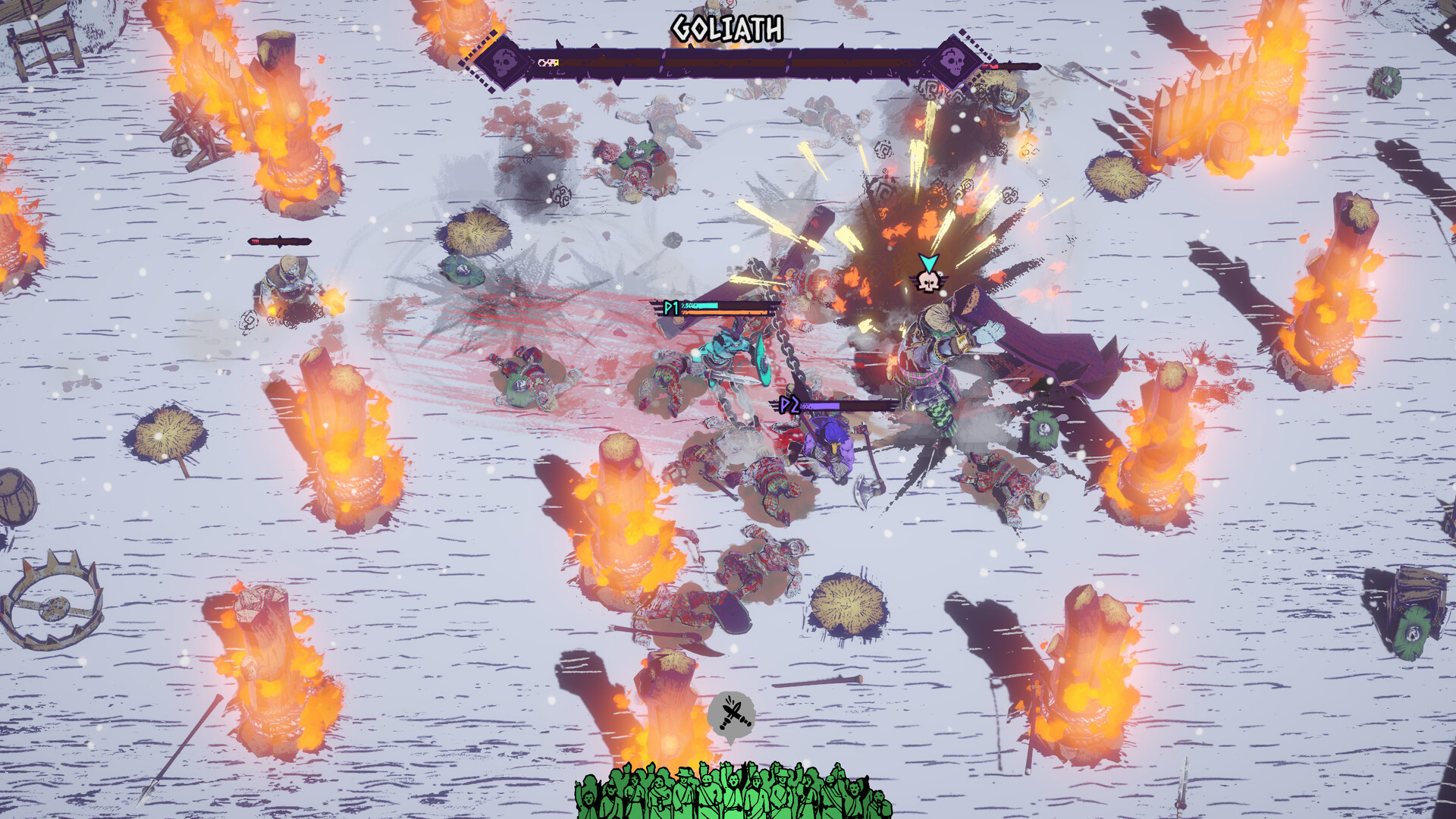
Combat is described as brutal and physical. You hack at enemies up close, or you make the arena do the work. The studio's examples are specific enough to plan around: throw a heavy object, throw an enemy into that object, charge someone into spikes, or dump them into a pit of snakes. Ranged attacks exist, but they are borrowed. Throw a weapon and you had better be holding another, or the next exchange starts with you unarmed.
The chain is the other weapon. The trailer tells players to turn it on their foes or be dragged down by it. The site makes the failure state vivid: poor coordination wraps the group around a pillar, or worse. Good timing trips enemies and flips a bad position. That is not a passive rope. It is a spacing tool with a friendly-fire personality.
On Chained Beasts console, the useful habit is a short callout loop, not a silent combo video. Name the hazard, name the pull, then move. A four-word bark beats a paragraph while snakes are in the pit and an urn is already in the air.
| Tool | Best use | Failure you should expect |
|---|---|---|
| Close cuts | Finish staggered foes and win style points | Trading hits you cannot afford while injured |
| Thrown objects | Open a fight or punish a clustered pack | Whiffing and giving the pack a free approach |
| Hazard charges | Spikes, pits, and other arena traps | Charging yourself into the same hazard |
| Thrown weapons | Pick off a dangerous target at range | Standing there with nothing in your hands |
| Synced chain pulls | Trip, reposition, or drag a foe off balance | Tangling the party on a pillar or each other |
A practical drill, once you can actually play, is three rooms with rules rather than score-chasing:
- Room one: nobody throws a weapon unless a second weapon is already equipped or on the ground in reach.
- Room two: one player calls every hazard, and the others only charge on that word.
- Room three: the group must land one chain trip before anyone spends a big purchase.
Those constraints teach the systems the marketing actually describes. They also stop a strong solo player from "carrying" friends into a tangle.
Party Roles That Keep Four Players Untangled
A Chained Beasts console party of four does not need four identical gladiators. The site says friends are chained in cruel and creative ways, and that each run pushes you down a different path. Roles can shift when someone unlocks a new character or buys a weapon that changes range. Still, starting with jobs keeps the tether from becoming a slapstick failure every fight.
Think in responsibilities, not classes. Someone watches the chain and the geometry. Someone commits to damage. Someone looks for urns, spikes, and pits before the pack arrives. Someone tracks coin, spare weapons, and whether the group can survive another elixir. The fourth job matters more than it sounds, because the economy and the medicine are how a bad day becomes a dead run.
| Role | Primary job | Callouts that help | When to switch |
|---|---|---|---|
| Anchor | Keep the chain off pillars and out of pits | "Slack," "wrap left," "stop" | If a limp makes them too slow to lead |
| Striker | Land the committed hits and chain trips | "Trip now," "I'm in" | If they are the only one still armed |
| Setter | Aim bodies and objects at hazards | "Urn," "spikes," "pit" | If hallucinations make their reads unreliable |
| Quartermaster | Weapons, coin, medicine, backup plans | "Second weapon," "don't drink" | If a new character ability replaces shopping |
Four ferocious friends is the studio's own phrasing, and it is also the stress test. Two players can improvise. Four players create crossing lines. Agree on a default formation before the match: anchor front-left, striker front-right, setter slightly behind the hazard side, quartermaster on the safe edge with a spare weapon. The formation will break. The point is having a shape to return to after it breaks.
Rotate the anchor every run if the same person always gets blamed for tangles. Chain mistakes are usually a timing problem, not a personality flaw. A group that treats them as coaching will last longer than a group that treats them as griefing.
Wounds, Elixirs, and the Price of Another Day
Each day in the arena adds injuries. The public examples are nasty and mechanical, not just flavor text. A limp changes how you move. A missing eye changes what you can see. Hallucinations make you swing at things only you can perceive. Potions ease pain and can leave you with a worse condition. Surgery is floated as another answer, which is a polite way of saying the "heal" might be a gamble.
That is the survival layer under the spectacle. A full health bar in a typical action game tells you that you are fine. Here, "alive" can still mean slow, half-blind, or arguing with ghosts. The trailer calls the medicine putrid and warns about side effects. Plan as if every drink is a trade, not a refund.
| Affliction described publicly | How a party should read it | Safer response | Risky response |
|---|---|---|---|
| Painful limp | Repositioning and charges get worse | Shorter commits, let the setter start fights | Asking that player to anchor |
| Missing eye | One side of the arena is a blind spot | Buddy calls on that flank | Solo flanks and long throws |
| Personal hallucinations | Their targets may not be real | Confirm before spending weapons or coin | Following their charge into empty space |
| Elixir side effects | Pain drops, a new problem may arrive | Drink for a specific upcoming fight | Chugging between every room |
| Surgery as an option | A possible fix with an unknown cost | Save it for a run-ending injury | Using it as a casual reset |
Build a three-question check before anyone drinks or goes under a knife:
- Which fight in the next stretch actually requires this body to move or see clearly?
- What new problem can we still win with, and what problem ends the run?
- Do we have a spare weapon and a chain plan if this person comes back worse?
If you cannot answer those, skip the elixir and change the route. The site is explicit that struggle also forges a fighter: skills, crowd support, purchased gear, and new characters are the clean power. Medicine is the dirty power. Groups that lean only on the dirty power will meet a boss already stacked against them while debating whose hallucination is the real lion.
Crowd favor belongs in the same conversation. Fighting with flair is not just a trailer line. The site says a won-over crowd will have your back. Style is a resource that does not carve a new hole in your leg. Spend a second on a readable, coordinated trip instead of a panic elixir, and you may get help that does not poison you.
Building a Run Toward Brutal Bosses
Fame is the difficulty dial. As it rises, you face arena heroes who show up armed with every advantage. The deck is stacked. Winning still moves you toward Rome and the choice the premise keeps circling: freedom, or revenge on your masters. That is a longer arc than a single brawl, so a run needs a spending plan.
Early fights should buy information. Learn how this party's chain behaves, pick up a backup weapon, and only take environmental risks you can name out loud. Mid-run is where identity shows up. Skills learned in the arena, a weapon that matches your role, and a crowd that actually likes you will matter more than a random expensive toy. Bosses are where you stop experimenting. Pick one hazard, one chain cue, and one person who is allowed to spend the last elixir.
| Phase | Priority | Good purchase | Bad habit |
|---|---|---|---|
| Opening rooms | Spacing, a second weapon, one safe hazard | Cheap gear that covers an empty hand | Throwing your only weapon for style |
| Mid-run | A skill, a crowd moment, a role identity | Equipment that fixes today's wound | Copying last run's build blindly |
| Pre-boss | One plan and full callouts | The item that enables that plan | Shopping because the menu is open |
| After a win | Bank the lesson, note the path you did not take | Unlocks and characters for next time | Assuming the next boss repeats the trick |
The site says each run asks you to take a different path, and that new characters arrive with powerful abilities. Do not freeze a "best team" after one good night. Write down three notes instead: which chain cue worked, which injury ruined a role, and which purchase you never used. Those notes are more useful than a tier list nobody official has published.
Boss prep can stay simple because the public description is simple. They are stronger, better equipped, and favored by the setup. Your counter is not a secret weak point from a wiki. It is arriving with spare weapons, a crowd you have already earned, and a chain that is not wrapped around the set dressing. If the group is hallucinating, limping, and holding one knife between them, the honest call is to stabilize or end the run on your terms.
A Session Plan You Can Use on Console
Chained Beasts console sessions go sideways when everyone discovers the tether at the same time as the first pit. Spend ten minutes before the blood starts. You do not need a spreadsheet. You need names for hazards and permission to say "stop."
| Minute | Do this | Why it pays off |
|---|---|---|
| 0–2 | Pick anchor, striker, setter, quartermaster | Stops four people grabbing the same job |
| 2–4 | Agree on four words: urn, spikes, pit, trip | Matches the combat the studio actually shows |
| 4–6 | Set a throw rule: no throw without a backup | Prevents the empty-hand death the site warns about |
| 6–8 | Decide who may drink an elixir | Keeps side effects from stacking in silence |
| 8–10 | Name the session goal: survive, earn the crowd, or test one character | Gives a bad run a reason to continue |
A few extra rules keep the night friendly:
- The anchor's "stop" overrides a stylish idea. Style can wait one second.
- If someone says they are seeing things, the party confirms targets before charging.
- Coin spent on a weapon nobody can use is a lost run, not a joke purchase.
- After a wipe, one sentence each: chain, hazard, or buy. Then move on.
- Switch characters when a limp or a lost eye has made someone's job impossible.
None of that requires leaked numbers. It is just respect for systems that are already on the studio page. The trailer tells you to fight through the pain and unleash an inner beast. The page tells you the pain is literal, cumulative, and only partly optional. Groups who romanticize the first line and ignore the second will blame the game for a planning failure.
If you are the person organizing the night, send the role table before anyone launches the game. Ask each friend which job they want and which injury would make them swap. That single message prevents the classic co-op collapse where the loudest player takes every decision and the chain does the rest.
What to Watch While You Wait
Until you have your own runs, judge coverage against the feature list rather than against hype adjectives. A useful preview shows the tether changing a fight, a thrown weapon creating a real risk, an injury changing movement or vision, and a purchase that matters later. A weak preview is all execution and no chain. The chain is the game.
When patches or extra platform news appear, update your expectations in this order: party size and play distance first, then how wounds display on a shared screen, then how readable boss advantages are. Those are the console questions. A longer combo list is optional. A chain you cannot see is not.
Chained Beasts console will feel fair only if the group can tell why it died. Tangled on a pillar, emptied your hands, drank a cure that lied, or met a famous killer with no plan: those are readable deaths. If your sessions produce those stories, the design is doing what the trailer and the studio page describe. If it produces only confusion, wait for clearer presentation before you judge the difficulty.
FAQ
Is Chained Beasts console only for four players?
The public pitch is co-op for up to four ferocious friends, chained together. That is the party the systems are built around. The materials used here do not spell out a dedicated solo ruleset, so do not assume a lone gladiator gets the same chain puzzles. If you mainly play alone, check the official page again before you buy.
Which platform is actually confirmed?
The trailer is presented as a PS5 game and ends on PlayStation. That is the solid console signal. It is not, by itself, a full platform matrix. Look at the Featherweight Games page and the store listing you trust for anything beyond that PlayStation trailer.
Do elixirs just heal you?
No. Both the trailer and the studio description warn that pain relief comes with side effects, and some afflictions can be stranger than the wound you started with. Treat medicine as a tactical gamble, and look at surgery the same way: a possible answer, not a free undo button.
What should a new group practice first?
Practice chain calls, backup weapons, and one environmental kill before you care about bosses or character unlocks. A party that can trip an enemy without wrapping a pillar already understands the fantasy. Crowd favor, coin, and brutal arena heroes matter more once that habit is in place.
Related Guides
Chained Beasts nintendo switch: Arena Co-op Guide
A practical look at Chained Beasts on Nintendo Switch: co-op chains, arena combat, wounds, bosses, and buying checks.
Chained Beasts ps5: Arena Guide for Players
See how Chained Beasts plays, how chained co-op works, and what PS5 players should confirm before buying this gladiator roguelike.
Chained Beasts Steam Deck: Status, Controls, Tips
Chained Beasts Steam Deck support is still Unknown. See controls, co-op limits, launch price, and how to test the demo on handheld.
Chained Beasts full release date: Oct 15, 2026
Chained Beasts full release date was October 15, 2026. Check price, co-op setup, the sale window, and the update roadmap.
Chained Beasts Demo Download: Steam Guide 2026
Download the Chained Beasts demo on Steam, check PC specs, and learn what the 2026 co-op gladiator roguelike demo includes.