Chained Beasts gameplay: Combat and Survival Guide
Master Chained Beasts gameplay with practical tips for chain combat, co-op positioning, arena hazards, builds, and affliction management.
What Makes Chained Beasts Different?
Your chain can trip an opponent—or pull a teammate into trouble—and that tension defines Chained Beasts gameplay. Understanding positioning, crowd rewards, and the cost of recovery matters because surviving one arena is only part of surviving a run. This guide explains the core systems behind Chained Beasts gameplay, with practical ways to approach solo fights, coordinate in co-op, and make better decisions between battles.
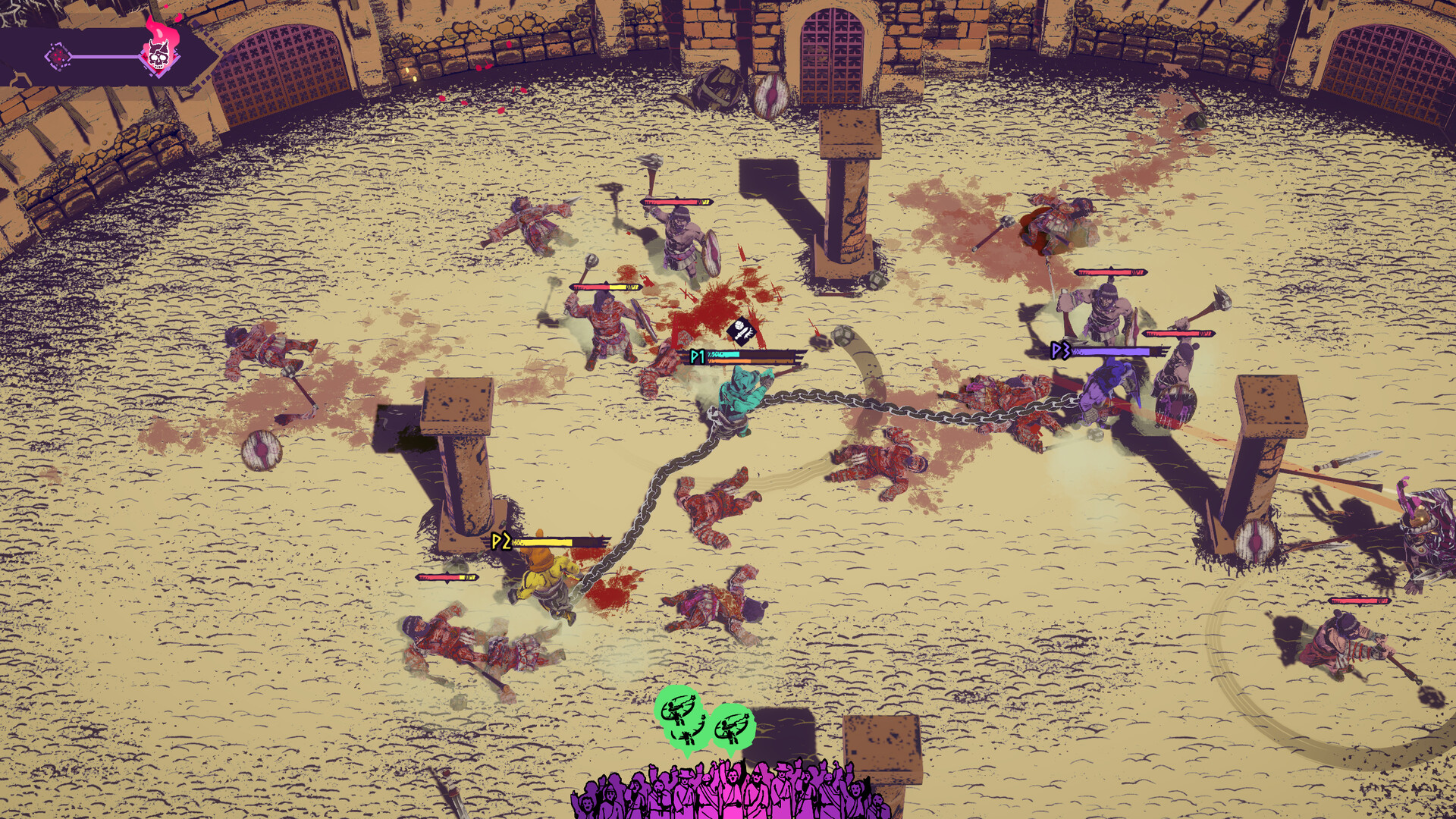
Official screenshot · Source: Steam store
Chained Beasts is a gladiator roguelike built around increasingly dangerous arena encounters. Your route takes you through Carthage, Germania, and eventually Rome, with opportunities between fights to develop your character.
Source note: The mechanics below are drawn from a full-release Chained Beasts player-experience breakdown, not firsthand testing. Strategic recommendations are deductions from those reported systems, rather than verified optimal strategies. For current availability and published feature details, check the Chained Beasts search results on the official Steam store.
Understand the Run Before Chasing a Build
The basic rhythm alternates combat with preparation. Winning a fight matters, but the condition in which you leave it also affects your next decision.
| Stage | What happens | Practical priority |
|---|---|---|
| Arena battle | Fight enemies using weapons, chains, and environmental hazards | Survive without taking unnecessary damage |
| Performance scoring | The crowd rewards aspects of your fighting style | Add variety when it is reasonably safe |
| Equipment decisions | Buy equipment between encounters | Address a weakness in your current setup |
| Character development | Train, select abilities, and later access surgeon upgrades | Choose improvements that support one another |
| Recovery decisions | Healing can introduce an affliction | Weigh restored health against a lasting drawback |
A useful beginner goal is simply to leave each battle with options. Spending health for one flashy kill may earn money, but it can also force a difficult recovery choice afterward.
How Chains Work in Solo and Co-op
The defining feature of Chained Beasts gameplay is that movement affects more than your own character. A chain is both a restriction and a tool, so treating it as background decoration misses a major source of tactical depth.
In co-op, up to four players are physically connected. Moving away from someone can drag them out of position, but coordinated movement can also stretch the chain across enemies and trip them.
Solo play changes the arrangement. Instead of being linked to teammates, you can be attached to an arena anchor or a heavy object that you must pull around.
| Chain setup | Main constraint | Offensive opportunity | Recommended habit |
|---|---|---|---|
| Co-op connection | Teammates influence one another’s movement | Stretch the chain across an enemy’s path | Agree on a shared direction |
| Solo arena anchor | Movement is limited by the attachment | Position the chain across approaching enemies | Check your escape route before committing |
| Solo heavy object | Repositioning involves dragging an object | Combine chain placement with nearby hazards | Move deliberately rather than retreating blindly |
Make Co-op Movement Predictable
The simplest coordination improvement is to announce major movements. “Backing toward the wall” gives teammates useful information; silently dodging away may create an unexpected tug.
Try these habits:
- Choose a shared retreat direction before engaging a dangerous group.
- Avoid splitting around obstacles without checking where the chain runs.
- Call out hazard setups so a teammate does not pull you away from an opportunity.
- Pause and regroup when players start dragging one another in conflicting directions.
These are coordination suggestions, not requirements for fixed team roles. The objective is to reduce accidental interference while keeping the chain useful.
Treat Solo Positioning as a Resource
According to the cited player experience, solo chaining can sometimes feel frustrating. A sensible response is to check your available movement before entering melee range.
Look at your attachment, the enemies’ approach, and the nearest hazard. A slightly less aggressive position may leave you enough room to block, dodge, or guide an enemy across the chain. That is usually preferable to discovering your movement limit while already under attack.
Combat, Arena Hazards, and Crowd Rewards
The reported combat toolkit includes melee weapons, shields, bows, thrown attacks, dodging, and blocking. Well-timed blocks can stun many enemies, giving defensive timing a practical offensive payoff.
However, Chained Beasts gameplay gets much of its variety from what surrounds those fundamentals. You can throw pots, send enemies into spikes, burn opponents, hurl weapons, and even use severed body parts as improvised weapons.
| Combat option | Reported function | Suggested use |
|---|---|---|
| Timed blocking | Can stun many enemies | Create an opening without immediately retreating |
| Dodging | Helps avoid attacks | Reposition while respecting chain restrictions |
| Weapon throws | Let you throw weapons across the arena | Consider them when direct melee positioning is poor |
| Environmental attacks | Use spikes, fire, and throwable objects | Look for opportunities before committing to a prolonged exchange |
| Chain positioning | Can trip enemies | Shape an enemy’s approach rather than only chasing them |
| Executions | Can improve crowd rewards and support certain builds | Use available opportunities without ignoring nearby threats |
Learn One Defensive Habit First
Before experimenting with every object in the arena, establish a reliable defensive routine. Timed blocking is worth practicing because its reported stun effect can turn an enemy’s attack into your opening.
Do not assume it works against everything. The source describes stunning many enemies, not every opponent or every attack. Observe the result, then adjust instead of repeating a failed response.
Balance Spectacle Against Survival
The crowd scores your performance, and executions, weapon variety, and creative kills can improve your earnings. That makes repetitive, low-risk combat potentially less profitable—but taking reckless damage is not automatically worthwhile.
A practical decision order is:
- Secure space: Avoid becoming trapped or pulled into danger.
- Identify an opening: Look for a vulnerable opponent or useful hazard.
- Add variety: Use an execution, different weapon, or environmental kill when manageable.
- Reset: Reassess your position before attempting another flourish.
For example, if an enemy is already near spikes, attempting an environmental kill may be sensible. Crossing a crowded arena solely to force that same outcome introduces a different level of risk.
The takeaway for Chained Beasts gameplay is to pursue spectacle opportunistically, not at the expense of every other priority.
Building Your Gladiator Between Battles
Between-fight choices give a run its identity. The reported options include buying equipment, taking optional challenges, training to level up, selecting abilities, and eventually visiting a surgeon for more substantial upgrades.
Rather than buying every individually appealing improvement, identify what your current character already does well. Then look for choices that reinforce it or solve a specific weakness.
The cited player experience describes several possible build directions:
| Build direction | Reported focus | What to evaluate before committing |
|---|---|---|
| Punching-focused | Build heavily around unarmed attacks | Whether your available upgrades support that approach |
| Execution economy | Generate money through executions | Whether you can create execution opportunities consistently |
| Critical-hit control | Repeatedly stun enemies through critical hits | Whether your upgrades work together reliably |
| Affliction synergy | Gain benefits from accumulating afflictions | Whether those benefits justify the actual penalties |
These are reported examples, not a ranked tier list. The source does not provide exact item names, damage values, or complete upgrade recipes, so a precise “best build” claim would go beyond the available evidence.
Use a Simple Upgrade Filter
Before committing resources, ask:
- Does this help my main approach? A specialized upgrade should support something you actually use.
- Does this address my biggest problem? More damage may not solve restricted movement or unreliable defense.
- What is the downside? Training and recovery can involve consequences beyond their immediate benefit.
- Can I use it now? A powerful-looking interaction has limited value if its supporting pieces are missing.
This approach keeps Chained Beasts gameplay decisions grounded in the run you have, rather than an ideal build you hope to assemble later.
Optional challenges deserve the same scrutiny. Consider your current health and accumulated penalties before accepting more risk. An additional opportunity is not necessarily the right opportunity for a struggling character.
Healing, Training, and Affliction Management
Afflictions make recovery more complicated than simply restoring a health bar. According to the source, healing usually carries a downside, and pushing training too far can also leave you with a negative effect.
Reported examples include a shorter dodge roll, obscured vision around corpses, and hallucinated enemies. These penalties affect different parts of combat, so counting afflictions alone does not tell you how dangerous a character’s condition has become.
| Reported affliction | Potential practical problem | Suggested adjustment |
|---|---|---|
| Shorter dodge roll | Familiar escape distances may no longer work | Relearn your spacing before taking aggressive risks |
| Obscured vision near corpses | Nearby threats become harder to read | Favor clearer fighting space when available |
| Hallucinated enemies | Target selection becomes less reliable | Avoid chasing every apparent threat immediately |
| Multiple accumulated afflictions | Penalties may interfere with several habits | Assess their combined effect before accepting another |
Judge the Penalty Against Your Playstyle
A shorter dodge can be especially disruptive if dodging is your main defensive habit. Visual interference may be more troublesome when you already struggle to track enemies in a crowded arena.
Before healing, ask two questions: Can I realistically survive the next fight without recovery? What might another penalty do to my ability to survive afterward?
There is no universal answer established by the source. Refusing recovery at critically low health can be reckless, while accepting every penalty without considering its impact can gradually undermine a promising run.
Affliction Bonuses Are Not Free Power
Some upgrades reportedly reward having more afflictions, while others can remove or compensate for them. That creates a compelling risk-reward loop, but a synergy does not automatically cancel the practical cost.
For Chained Beasts gameplay, the useful distinction is between a penalty you can manage and one that breaks your current approach. Build around afflictions when the benefits and drawbacks make sense together—not simply because a higher count activates a bonus.
The source also reports multiple characters, variants, traits, and harder modes with additional modifiers. Those options provide reasons to experiment after you understand the basic systems, rather than forcing every run toward the same setup.
Chained Beasts Gameplay FAQ
Can you play Chained Beasts solo?
Yes. In solo play, you can be chained to an arena anchor or a heavy object instead of another player. The cited player experience notes that this restriction can occasionally be frustrating, so checking your movement limits is particularly important.
How many players can play together?
The source reports co-op for up to four players, with players physically chained together. Coordinated positioning can help trip enemies, while conflicting movement can drag teammates out of position.
What should beginners prioritize?
Start with defensive timing, chain awareness, and manageable upgrade choices. Learn how movement restrictions affect your escape routes, then add environmental attacks and crowd-pleasing variety when you can do so safely.
Is Chained Beasts gameplay mostly about melee combat?
No. The source describes the underlying melee system as relatively straightforward. Much of the depth comes from chain positioning, arena hazards, crowd rewards, build synergies, and deciding whether healing or training is worth another affliction. Learning how those systems interact is more useful than focusing on attacks alone.
Related Guides
Chained Beasts Afflictions Guide: Potions vs Surgery
Chained Beasts afflictions can wreck a run. Learn potion risks, surgery trade-offs, and which injuries to carry into the next arena.
Chained Beasts guide: Co-op Arena Survival Tips
Master chains, afflictions, crowd favor, and co-op builds in this Chained Beasts guide for Carthage, Germania, and Rome.
Chained Beasts how to pose in Arena Fights
Position chained gladiators so the line stays clear, hazards work for you, and bosses do not wrap the whole team.
Chained Beasts full release date: Oct 15, 2026
Chained Beasts full release date was October 15, 2026. Check price, co-op setup, the sale window, and the update roadmap.
Chained Beasts Steam: Co-op Arena Combat Guide
Learn how Chained Beasts Steam plays: chain combat, co-op, afflictions, shops, and beast unlocks from a real arena run.