Chained Beasts guide: Co-op Arena Survival Tips
Master chains, afflictions, crowd favor, and co-op builds in this Chained Beasts guide for Carthage, Germania, and Rome.
Most co-op brawlers hand you upgrades until the AI stops mattering. Chained Beasts does the opposite. A Chained Beasts guide is worth reading before you queue, because the fun and the failure both come from the same rope. This Chained Beasts guide covers how the chains rearrange each fight, why stronger potions can ruin a run, and how a four-player crew should spend shared gold on the road from Carthage to Rome.
The full game launched on October 15, 2026, with listings for PC, PlayStation 5, Xbox, and Nintendo Switch. You can play alone or with up to three friends. The official Chained Beasts overview from Featherweight Games describes arena combat that lets you hurl urns, shove foes into spikes or snake pits, and throw weapons you may not get back. Chains, bosses, and lasting wounds are the other three pillars.
Why This Arena Punishes Power Fantasies
Roguelites often front-load pain, then let synergies snowball. Chained Beasts keeps health between bouts and stacks afflictions while you gain skills and gear. You also limp, drop weapons, and mis-throw. The body gets worse as the build gets better.
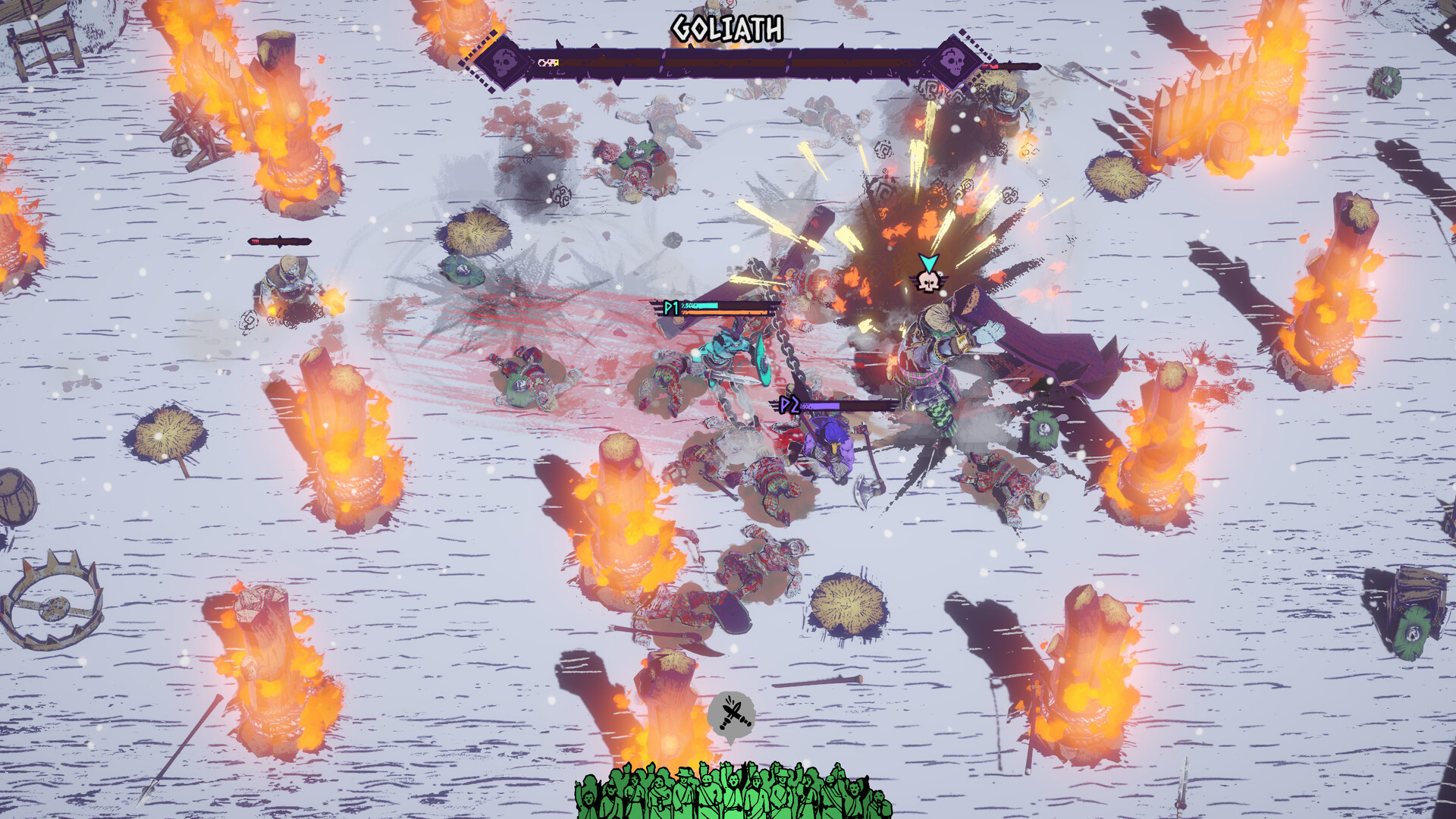
Official screenshot · Source: Steam store
Player experience describes heavy hitters who still miss because nearsightedness blacks out the screen edge. Plan for unreliable inputs, not a perfect combo string.
| Snapshot | Full release |
|---|---|
| Developer | Featherweight Games |
| Platforms | PC, PS5, Xbox, Nintendo Switch |
| Party size | 1–4, online or local |
| Campaign | 3 acts, 9 battles |
| Difficulty | 10 levels |
| Roster | 8 beasts, plus variants |
| Skills | 70+ |
| Afflictions | 70+ physical and mental |
| Items | 40+ purchasable |
| Launch | October 15, 2026 |
Treat the rest of this Chained Beasts guide as a coordination manual: one formation, one wallet, one vote on the ugly debuff. Solo teaches throws. It does not teach chain calls, the snatch, or who sells a kidney. Use solo to learn buttons. Bring voice chat for the real loop.
Chain Setups and How to Fight Inside Them
Community reports describe several binds, not one leash. Pairs can be linked. Three fighters can share a chain while one runs free. The party can be tied to a heavy ball or two smaller ones. Rare items sever a chain, which is worth saving when you are bound twice. Maps add anchors, wheels, spikes, and pits.
Four gladiators in a straight line are the friendship test. Chargers on the ends drag the middle into harm. Player experience of the wipe is specific: panic, a lap around a pillar, a tighter wrap, a downed fighter, and a knot everyone else wears.
| Layout | What changes | Call to make |
|---|---|---|
| Paired links | Two separate leashes | Split, but not around one pillar |
| Three plus a free fighter | Loose player is your reach | Flank; keep the trio compact |
| Four in a line | Ends steer the squad | Talkers on the ends |
| Ball and chain | Mass trips and drags | Do not build a sprint |
| Anchor or wheel | The floor directs you | Swing after you read the spin |
| Sever item | Breaks a link | Save it for a double bind |
Light and heavy attacks, blocks, parries, executions, and throws share one rule with hazards: variety. Trip with the chain. Throw a weapon or a snake jar only if another weapon is already in reach. Jars do not care who is friendly.
Crowd favor is live. Spam one kill and the stands boo. Player experience says debris then hits you. Some perks pay you for not being the favorite. A reported narcissist affliction can hide allies, so you stab the person you are comboing next to.
Winning the crowd is not only a meter. Official framing says the stands can have your back, and player experience says the opposite is junk thrown at your head. Mix an execution, a hazard kill, a chain trip, and a throw in the same bout. If a teammate’s perk wants them unpopular, let them clean up while someone else does the flashy work.
Downed rules, from the same player experience: a lone survivor can finish the bout, crawlers can be executed, and rescued fighters come back near one health. Style is how that survivor throws the run. Community reports on Steam’s shared-screen notes also say local play expects at least one gamepad.
Healing, Afflictions, and the Surgeon
Health persists, which is why potions matter more than another damage card. Go down and get carried, and player experience puts you near one hit point. Heals between rounds follow a reported skull scale from one to three: more recovery, worse side effect. Potions are where a Chained Beasts guide earns its keep, because the “correct” heal can delete the sense you fight with.
Official copy and player reports add limps, a missing eye, private hallucinations, black-and-white sight, nearsightedness, sprint fatigue, and drifting throws. A few named effects already show how personal this gets.
| Affliction | Effect to plan around | Co-op fix |
|---|---|---|
| Annoying | Nearby allies may attack you | Give the chain slack |
| Impulsive | New skill every second level; buy every shop | Pre-budget the purse |
| Infatuated | Camera on an ally; +10% if they watch you | Face them, then reset |
| Bad vision | Edges or half the screen go dark | A caller starts fights |
| Fumbles | Drops and off-center throws | Stop fancy ranged plays |
| Hallucinations | You swing at private targets | Obey the voice call |
| Choice | Gain | Risk |
|---|---|---|
| Small potion | Patch chip damage | Mild drawback |
| Mid potion | A safer bar | A build-changing debuff |
| Full heal | Everything back | Often a brutal penalty |
| Skip | No new affliction | One hit ends you |
| Surgery | Cure or gold | Future potions shift |
Player experience puts surgery next to those potions. A sold kidney has been reported around 200 shared gold, with later drinks more punishing. A third kidney, in those reports, eases the penalties. Fund the squad on purpose. Do not discover the trade after the animation.
At half health before a normal fight, take the small potion. At one health before a boss, the skull-three drink can be right if one person volunteers. Announce the debuff. Surprises wipe more runs than limps do.
Drafts, Beasts, and Shared Gold
Each break also deals power. In four-player sessions, player experience shows one card per fighter, all visible, plus one communal card. Lock yours or snatch the middle by giving yours up. Speed wins the grab. Talk should win the minute after.
That second beat is the real system. A precision skill is wasted on a half-blind fighter. A gambling perk—players describe bets that sometimes pay the team and often miss—belongs to someone who can whiff. With 70-plus skills, 40-plus items, and eight beasts, jobs beat a fake tier list:
- An initiator who can stand near spikes and pits.
- A thrower who keeps a spare weapon in mind.
- A crowd fighter who varies the kill.
- A stabilizer who will not orbit pillars.
- Snatch only to fill a hole you already named.
- If Impulsive is active, leave gold for the forced buy.
The developer’s progression pitch is straightforward: skills from experience, crowd favor, bought gear, and new characters with different abilities. Each run is supposed to fork. Pick the beast for the hole in the party, then let afflictions rewrite the plan.
Read every dealt card before anyone moves. The middle option is not automatically best. A useful Chained Beasts guide treats this draft as social, not as four solo optimizers.
Acts, Bosses, and a First Clear
The route is three acts and nine battles. Carthage, also the demo setting, is where chain language should stick. Campaign write-ups put Germania in the frozen north, with new foes, spike traps, and a boss named Goliath. Rome is last. Those same notes name Praefectus and the Praetorian Guard.
| Act | Setting | Practice target |
|---|---|---|
| Carthage | Opening chapter | Calls, throws, backup weapons, small potions |
| Germania | Frozen north | Spike lines and the Goliath fight |
| Rome | Last chapter | Crowd variety, economy, Praefectus |
| Replay | 10 difficulty levels | Same manners, less room for a selfish snatch |
You will not out-heal a champion. Pull them into spikes or a snake pit on a straight chain line. Trip the adds. Spend a sever item when a wheel or a second bind blocks the hazard, not on the first scratch.
Before Germania, fold these into your Chained Beasts guide notes:
- Stay on a low difficulty in Carthage until pillar calls are automatic.
- Assign chain ends before the gate. Move a visually impaired fighter off an end.
- Buy the smallest useful potion, unless a boss is next and one volunteer takes the harsh heal.
- Spend shared gold on a weapon the fumbler can afford to lose.
- After a wipe, change one rule only: ends, potion cap, or snatch etiquette.
Ten difficulty levels reuse the same maps with less slack. Climb after the manners exist. Freedom or revenge in Rome still requires one gladiator upright at the end. That checklist is the part of a Chained Beasts guide most groups skip until a pillar ends the night.
FAQ
Can I play alone?
Yes. A solo run is enough to learn throws, hazards, backup weapons, and why a big potion can be a trap. You will not get the snatch argument or a friend orbiting a pillar. Those are the multiplayer half.
How many players can join, and what should we bring?
The game supports one to four players online or locally. Community reports citing the Steam listing say shared-screen play expects at least one gamepad. Online, headsets matter more than a matched set of controllers, because chain direction has to be instant.
Which heal is usually a mistake?
Any full clear you did not discuss. Player experience treats a missing eye, blacked-out vision, and other skull-three results as boss-only tools. If the next fight is a standard arena and you are above half, buy the small potion and keep your eyes.
Does this Chained Beasts guide matter after the first clear?
Yes. Ten difficulty levels rerun Carthage, Germania, and Rome, and each attempt remixes beasts, skills, and more than 70 afflictions. The chain call and the heal rule still decide the night.
Related Guides
Chained Beasts how to pose in Arena Fights
Position chained gladiators so the line stays clear, hazards work for you, and bosses do not wrap the whole team.
Chained Beasts tips to Survive Every Arena Run
Practical Chained Beasts tips for chain fights, crowd favor, builds, afflictions, and co-op from Carthage to Rome.
Chained Beasts trophy guide: Roadmap and Tips
Plan a clean Chained Beasts platinum with a two-pass roadmap, missable checks, and a session log so you do not waste a second playthrough.
Chained Beasts full release date: Oct 15, 2026
Chained Beasts full release date was October 15, 2026. Check price, co-op setup, the sale window, and the update roadmap.
Chained Beasts switch: Co-Op Arena Survival Guide
See how Chained Beasts switch plays in online co-op: chains, afflictions, crowd favor, and handheld tips before you buy.