Chained Beasts tips to Survive Every Arena Run
Practical Chained Beasts tips for chain fights, crowd favor, builds, afflictions, and co-op from Carthage to Rome.
Chained Beasts tips matter the moment the chain yanks you off a clean hit and into a spike wall. This co-op gladiator roguelike from Featherweight Games punishes solo instincts: you share a physical tether, a rowdy crowd, and a pile of afflictions that can wreck a strong build. These Chained Beasts tips cover positioning, weapons, upgrades, and the punch-focused setups players are already calling broken, so your first run through Carthage does not end on the sand.
Featherweight shipped the game on October 15, 2026 for PC, PlayStation 5, Xbox Series X|S, and Nintendo Switch. You play an animal gladiator, alone or with up to three friends, and fight toward Rome. The loop is short enough to learn in an evening and messy enough that the same four players can lose to a pillar.
Learn the arena before you chase damage
Chained Beasts is a 1–4 player action roguelike. Fighters are physically chained, battles are arena brawls, and the campaign runs through three acts and nine fights, with ten difficulty levels waiting after you learn the sand. There are eight beasts, more than 70 skills, more than 70 physical and mental afflictions, and more than 40 items. That is a lot of toys. None of them save a team that cannot move together.
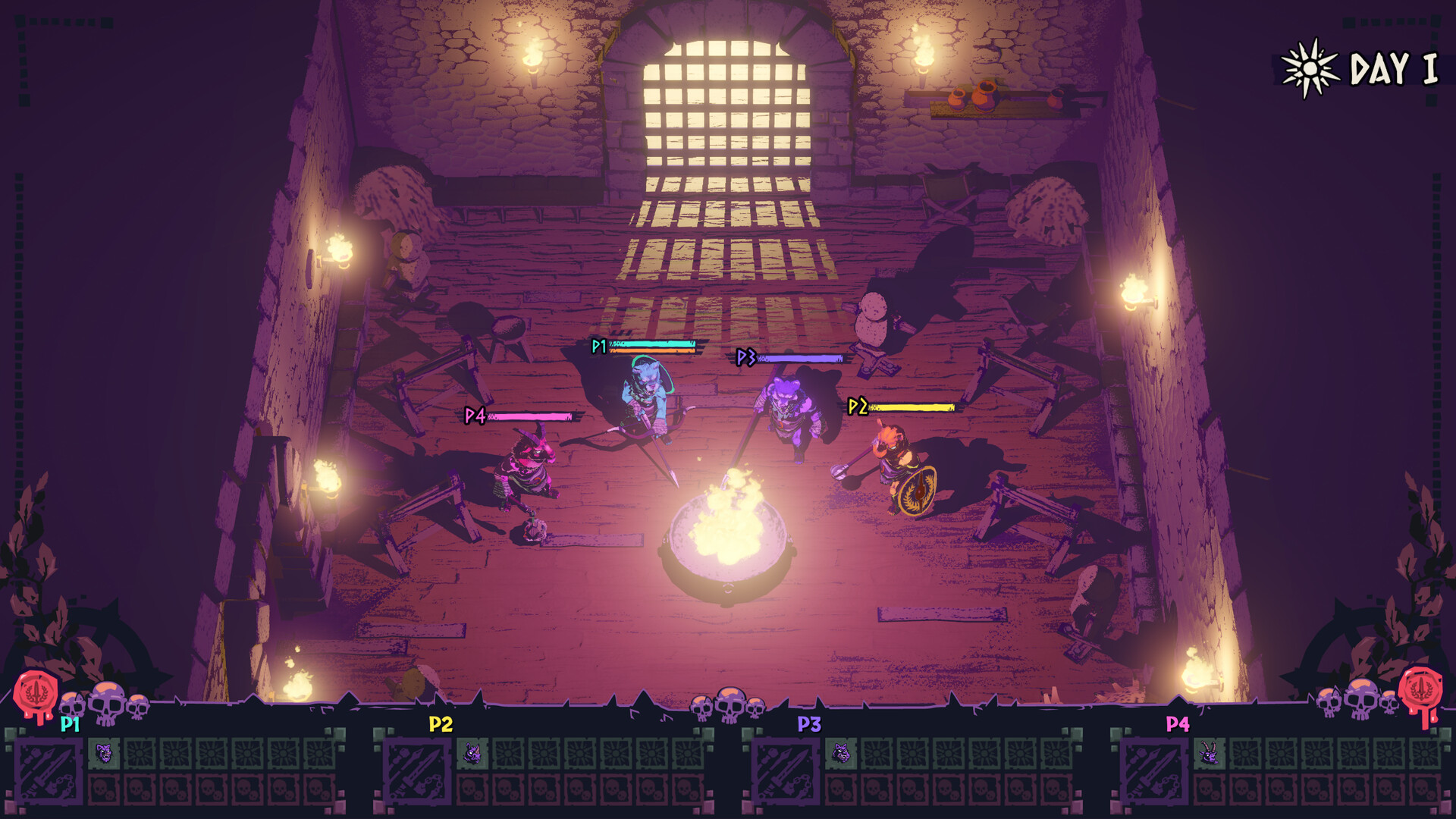
Official screenshot · Source: Steam store
Launch coverage lists a $19.99 price, a 35% discount to $12.99 for the first two weeks, and day-one availability on Xbox Game Pass Ultimate and PC Game Pass. Confirm the current store page before you buy, because launch pricing moves. The PC version is listed on Chained Beasts on Steam as well as the Microsoft Store.
Treat the snapshot below as the floor. The rest of these Chained Beasts tips assume you will get separated, blinded, or broke at least once.
| Detail | What it means in a run |
|---|---|
| Party | Solo or co-op, up to 4 gladiators |
| Route | Carthage, then Germania, then Rome |
| Boss pressure | Goliath in the north; Praefectus and the Praetorian Guard in Rome |
| Power curve | Skills and items spike damage; afflictions tax control |
| Win condition | Clear the wave, keep the crowd interested, still be able to walk |
Pick a beast for a job, not a costume. A slower, tougher body wants to hold the front. A faster beast wants flanks, throws, and hazard kills. In co-op, say the job out loud before the gate opens. Shared upgrades later will go to whoever is actually doing that job.
Your first clear goal is not a perfect build. It is leaving Carthage with three habits: you keep a spare weapon, you look before you execute, and you do not wrap the chain on the nearest post.
Move with the chain, not against it
The most reliable Chained Beasts tips start with the tether, not the talent tree. Connected gladiators do not get free movement. Pillars, tight lanes, heavy objects, and panicked revives all turn the chain into a second enemy. One player experience even called co-op "rough" compared with solo, which matches how often a good duel becomes a pileup once a teammate sprints.
Move as a pack unless someone calls a split. If you need to pass a pillar, take the long arc together. If a heavy object is tied into the encounter, decide who drags it before anyone attacks. In a doorway, the front fighter blocks and the back fighter throws. Crossing paths at the same time is how you stun yourselves on your own leash.
| Mistake | What the chain does | Fix before the next pull |
|---|---|---|
| Sprinting to a downed friend | Drags the last healthy player into the mob | Kill or trip the nearest threat first |
| Circling one pillar | Locks both of you out of swings | Reset wide, then re-enter as a pair |
| Throwing while a teammate dodges | Cancels the follow-up and feeds the crowd a whiff | Call "throw" and hold still for one second |
| Spreading to loot mid-wave | Leaves a gap the enemy walks through | Loot after the execute, not during the charge |
Use the chain on purpose. A short pull across an enemy's ankles trips them and opens a throw, a heavy hit, or a shove into spikes. That only works if the person on the other end knows the pull is coming. Surprise teamwork is just friendly fire with extra steps.
Solo versus a full chain
Solo still has the combat, the shops, and the afflictions. You miss the funniest failures and the strongest setup, which is one player embedding weapons while another cashes them in. Local shared-screen play on Steam expects a gamepad in the party, so do not plan a couch session on keyboards alone. Online is the cleaner way to practice spacing. Couch co-op is the better way to learn how loud you need to be.
When a teammate drops, read the wave before you commit. Sometimes the correct revive is after you trip the charger. Sometimes it is never, because a second body on the sand ends the run. Survival beats heroics in every act.
Fight with weapons, hazards, and the crowd
Weapon and crowd Chained Beasts tips are simple: never enter a wave with empty hands and a one-note combo. Light attacks find openings. Heavy attacks cash them in. Blocks and parries stop committed swings. Dodges matter most when the floor is worse than the sword, which is often. Throws hit targets you should not walk to. Executions finish low targets and also lock you in place while their friends swing.
Swords, spears, maces, and flails all change the range of that plan. Bows and hooked throws show up as specialty tools. The rule that survives every loadout is to keep a replacement within arm's reach. A beautiful spear toss that leaves you unarmed is a donation to the other team.
Hazards do the work your damage stat has not earned yet. Snake pits and snake jars, spike walls, planted spears, stools, and ballistae all appear as real kill tools in early arenas. Shove, throw, or tackle a tripped enemy into the hazard, then reset. Spikes do not always re-trigger on your schedule, so do not stand on them waiting for a second pulse. If you miss the shove, you are the one eating the trap.
| Tool | Best moment | Common miss |
|---|---|---|
| Block, then throw | Enemy just whiffed a guard | Swapping weapons by accident and eating the hit |
| Chain trip | Two of you can follow up | Tripping yourself with a bad affliction later |
| Hazard shove | Target is already stunned | Chasing them off the trap and into a mob |
| Execution | Lane is clear and health is low | Starting it while a net or spear is inbound |
| Spare weapon | You just threw your main hand | Walking across the arena to fetch it |
| Crowd mix-up | You have repeated the same swing | Favor drops and damage buffs never turn on |
The crowd is a system, not scenery. Repeating one swipe bores them. Varied attacks, throws, executions, and hazard kills keep favor up. That is style points with a mechanical edge: player experience includes a pickup that granted about 50% more damage while the crowd was going wild. You do not need that exact perk to care. A bored crowd is a wasted resource, and a wild crowd makes aggressive builds feel fair.
Shields are not optional flavor. Even a punch specialist still wants one for chargers and ranged pests. Pulling a shield off a weaker enemy, when you have that option, is often worth more than another raw damage trinket you cannot equip.
Build around a plan, not a random skill
There are more than 70 skills, so a random roll will tempt you every camp. Take it only when your core is already online. Otherwise you are collecting trivia while the next boss collects you.
Four directions cover most successful runs:
| Build | What you stack | When it shines | When it folds |
|---|---|---|---|
| Raw damage | Heavy hits, crits, boss burn | Short waves and isolated elites | You trade into a group and never get the swing back |
| Stun control | Longer stuns, trips, execute windows | Crowded Carthage rooms | Damage is low if the stun whiffs |
| One weapon | Mastery of spear, mace, sword, or flail | You can always see a backup on the ground | A throw, a disarm, or a bad camera leaves you bare |
| Unarmed bear | Fury on hit, punch crits, embedded weapons | After several specific skills align | The first half of the run, and any fight you cannot stick a weapon in |
Individual upgrades push your kit. Shared upgrades force a conversation. If two players want the same reward, give it to the build that converts it this battle, not the player who asked first. A stun extension on the trip specialist beats the same perk on a backline thrower.
Afflictions are part of the build, not a separate punishment screen. An upgrade that adds a drawback can still be correct. An upgrade that hides information, ruins vision, or makes you swing when you meant to block is often a trap, because this game already supplies enough chaos.
The bear punch package players are testing
Community Chained Beasts tips keep circling one unarmed bear setup. Treat the numbers below as player experience from a single deep run, not as guaranteed tooltips.
That run used a hulking bear: more health, less move speed, and a brief invulnerability plus fury after taking a hit. The player then hunted punch skills instead of a prettier weapon. Early fists did almost nothing. The build turned once several pieces overlapped:
- Brass knuckles, described in that run as a large punch-damage item, with a separate double unarmed damage option. Only one equipped item fit, so the slot was the whole build.
- A passive they called Drive It Home: punching a target makes weapons already stuck in that body deal melee damage again. It is the embedded hit, not a second copy of the throw.
- Fury every third punch, extra fury for hitting tripped enemies, and longer fury uptime. Half damage during fury showed up as a paired defensive perk.
- Crit chance on punches, punch crits that stun, and a perk that made the next attack a crit after you took damage.
- A reported 3% damage per affliction once red skulls stacked. That only pays if you can still see and swing.
The combo the player used was blunt. Stick spears, swords, or axes in the target, then punch to set that embedded damage off. In a party, everyone else should be the delivery service. The bear is the detonator. They reported elites and even bosses dropping in a handful of hits once the package existed, including a rushed 10-second kill attempt. Boss jumps can shake embedded weapons loose, so punch before the leap instead of admiring the pincushion.
Do not force this on act one. You will look foolish until fury, the item, and Drive It Home exist. Intoxication-style afflictions that crooked their walk also made throws miss, which deletes the setup. Vision afflictions that hide distant pickups are the same tax. If you cannot see the spear, you cannot load the punch.
A few supporting perks from that same community report are worth knowing so you do not misread them as base rules. Training that always granted two experience, even on a bad roll, snowballed levels. Shop prices reduced by about 40% made later buys realistic. Experience that stopped decaying after training protected the investment. None of those are reasons to ignore a downside that makes you attack your own block button.
Other beasts can steal half of this idea. Any fighter who can trip, throw, and crit will like stun-on-crit and hazard follow-ups. They will not get the bear's free fury-on-hit window. If your team only has one frontliner, that window is the reason to bring the bear at all.
Spend gold, training, and healing with intent
The spending Chained Beasts tips below are about saying no. Gold, training, and the surgeon all offer power with a bill attached. Healing is the sneakiest bill. Potions and recovery can put you back in the fight and still add an affliction, and some heals in player experience refused to top you off past about 80%. Read the cap before you drink.
| Choice | Take it when | Leave it when |
|---|---|---|
| Training XP boost | You want levels more than a clean bill of health | The next fight needs accuracy, not a new passive |
| Hidden training result | You are willingly rolling for speed | You still need to know which drawback you just earned |
| Shop discount | You will visit another shop with real gold | You are one purchase away from your core item |
| Random skill | Your build already functions | You are fishing for a name you saw online |
| Potion or healer | The next wave will kill you at this health | The affliction on the bottle breaks your inputs |
| Surgeon | One affliction is bricking the build | The cure costs the perk that makes the build work |
| Shared upgrade | One player converts it immediately | Taking it "for later" leaves the chain weaker now |
Training is where runs get greedy. Players report objectives as awkward as missing a set number of attacks. Do that on a safe wave, with an execute ready, not while a charger is in your face. If a result says you cannot see training strain or the affliction you just rolled, assume you rolled something annoying and play the next room slower. One runner liked that blindness because a "two XP every time" perk kept paying even when the die showed a one. That is a speed strategy. It is also how you walk into Germania unable to tell a real weapon from a bad idea.
Known affliction flavors are worth memorizing by type:
- Control taxes, such as swinging when you meant to block, or chain-trips that stun you too.
- Information taxes, such as a closer camera, brighter lights, or pickups you cannot see until you trip on them.
- Social taxes. Annoying can make nearby allies hit you. Infatuated yanks the camera toward an ally and adds damage while they look at you. Impulsive forces a new skill every second level and a purchase at every shop.
- Trust taxes. Guides on Psychosis talk about fake weapons, which is a co-op nightmare if someone throws the prop instead of the spear.
Stacking afflictions can be correct if you took damage-per-affliction and your attacks still connect. It is incorrect if you took them because the tooltip was shiny. "Hard learned lessons" style perks that ask you to play clean for a minute are fine on a punch build that wants to get hit later. They are miserable if the wave opens with mages.
Buy order for a normal run is boring and strong. First, a weapon you will still want after you throw it, plus a shield if the room has charges. Second, the item that defines the build, because one equipment slot means the second trinket is just inventory guilt. Third, a shop discount or training XP perk only if the next fight is already survivable. Saving gold on purpose, the way that bear runner did while broke in the 40s, is better than a random clinical-trial gamble you do not understand.
Between acts, cure the affliction that changes inputs before you cure the one that only changes flavor text. A limp is ugly. A limp plus invisible pickups plus a forced swing is how runs end.
How the three acts should change your habits
Carthage is the tutorial the game pretends is not a tutorial. Practice hazard kills, backup weapons, and calling chain pulls. If you cannot trip someone into a snake pit here, Germania will not magically teach you.
Germania adds cold-arena pressure, more spikes, and Goliath. Bring the stun and the spare spear. Do not meet a large boss with your only weapon already airborne and your chain wrapped on scenery.
Rome is the crowd, the guard, and Praefectus. Player experience suggests bosses bring extra support and can invalidate a greedy "kill the big one instantly" plan. Clear or trip the escort first. Embedded-weapon punches still slap, but a jumping boss that sheds every spear you just threw will make you look like you missed on purpose.
Climb difficulties only after a clear where the chain was a weapon more often than a leash. Ten tiers is a ladder, not a personality.
FAQ
What Chained Beasts tips matter most on a first run?
Keep a second weapon, move as a group around pillars, and check the lane before every execution. Use snake pits and spike walls while your damage is still low. Take upgrades that match one plan, and skip drawbacks that hide the arena or force you to swing. Friends make the chain easier to exploit and harder to survive. Solo is a fair way to learn the buttons.
Can you play Chained Beasts alone?
Yes. The game supports one to four players, including online co-op and local shared-screen co-op. Solo keeps the roguelike upgrades, beasts, and afflictions. You lose the shared-upgrade arguments and the trick where teammates stick weapons in a boss for someone else to punch. If the fantasy you bought is chaotic teamwork, do not judge the game on a silent solo file alone.
Is the unarmed bear build actually that strong?
Community reports say yes, late. A hulking bear with fury and a short invulnerability on hit, brass knuckles or double unarmed damage, and a punch that re-triggers embedded melee damage can delete targets in a few hits. It is weak until those pieces exist, it uses your only equipment slot, and boss movement can clear the weapons you set up. Copy the pattern, not the highlight reel.
How should a co-op group handle downed players and shared loot?
Stabilize the wave, then revive. A rescue that drags the chain through three enemies is a wipe. Give shared upgrades to the build that uses them this fight. Call throws and pulls. If someone is on Psychosis or cannot see distant pickups, they should not be the team's scavenger. The frontliner holds aggro. Everyone else loads hazards, sticks weapons, and stays off the spike floor.
Related Guides
Chained Beasts guide: Co-op Arena Survival Tips
Master chains, afflictions, crowd favor, and co-op builds in this Chained Beasts guide for Carthage, Germania, and Rome.
Chained Beasts how to pose in Arena Fights
Position chained gladiators so the line stays clear, hazards work for you, and bosses do not wrap the whole team.
Chained Beasts trophy guide: Roadmap and Tips
Plan a clean Chained Beasts platinum with a two-pass roadmap, missable checks, and a session log so you do not waste a second playthrough.
Chained Beasts full release date: Oct 15, 2026
Chained Beasts full release date was October 15, 2026. Check price, co-op setup, the sale window, and the update roadmap.
Chained Beasts nintendo switch: Arena Co-op Guide
A practical look at Chained Beasts on Nintendo Switch: co-op chains, arena combat, wounds, bosses, and buying checks.