Chained Beasts demo multiplayer: Co-Op Guide
Learn how Chained Beasts demo multiplayer works: chains, afflictions, shared loot, crowd bonuses, and co-op tips from a full four-player run.
Playing a pit-fighter roguelike is chaotic enough. Doing it while physically tied to your friends turns every dodge into a group decision. Chained Beasts demo multiplayer is the version of that idea players have been stress-testing in co-op, and it matters because the chain is not a gimmick—it decides positioning, friendly fire, and whether a downed friend can even be dragged to safety. If you are jumping into Chained Beasts demo multiplayer with a squad, the systems below are the ones that actually change a run.
This guide is built from player experience, not a developer patch-notes dump. A four-player group that already liked the demo later recorded an early-access session and expected launch roughly two weeks after that sitting. Treat timing, difficulty names, and tooltip wording as community reports from that build. Numbers can shift, but the co-op habits will still save runs.
What Co-Op Actually Asks of Your Squad
Chained Beasts demo multiplayer is an online pit-fighter roguelike. You clear arena waves, draft boons, swallow afflictions, and push through biomes while a crowd scores the show. The session that informs this article was a full clear on the easiest listed setting, which the squad called pleb. They reached a late, day-10 style finale in one sitting and still spent half the run colliding with each other.
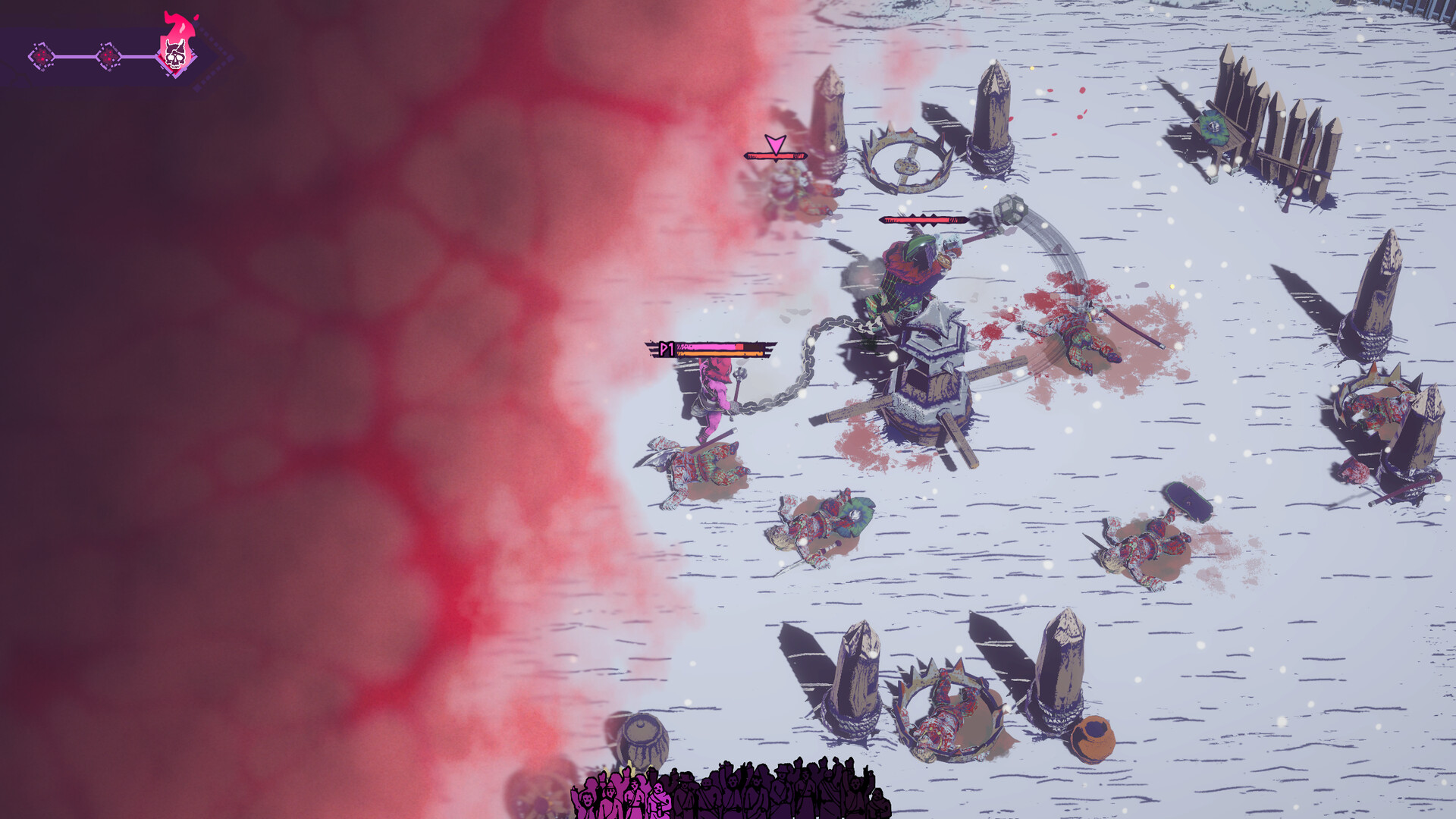
Official screenshot · Source: Steam store
Movement is the first surprise. One player tested whether sprinting inward would yank a friend farther into a swing. It did not. The link is not a slingshot. It is a reach limit. If an enemy sits on your side of the pit and the chain is taut, you can whiff while a teammate two body-lengths away assumes you are choosing not to help.
A published four-player early-access session shows the loop in practice: shared gold decisions, individual potion picks, and constant accidental hits. Use it as a vibe check, then run the jobs below so your own group is not inventing roles mid-boss.
| Role | Job in the pit | Why the chain cares |
|---|---|---|
| Caller | Picks a direction and a primary target | Stops the squad orbiting one pillar |
| Anchor | Holds a shield and blocks normal swings | Gives the line a stable center |
| Thrower | Embeds weapons and chucks bodies into hazards | Feeds punch payoffs and the crowd meter |
| Specialist | Owns one awkward objective | Flail kills and “miss exactly” tasks fail if everyone tries them |
Four players also change the draft. Community reports from this run say a bigger party simply sees more boons, so someone can beg for the piece their build wants instead of forcing a solo compromise. That is the real multiplayer advantage, ahead of raw damage.
How the Chain Wins or Wipes the Fight
The chain snags geometry. Pillars, poles, and tight corners turn a confident push into a carousel. In player experience, the middle link has the worst job: side spawns stay out of reach, and both ends keep walking. Call “stop” before the middle player is dragged into a bomb.
Spacing is also your friendly-fire plan. Short chains and a “fight everything in the middle” instinct put axes through allies. The squad’s best rounds happened when each player picked a different body. Overlap phases were safer when people threw instead of swinging. Throws still bean teammates—one player brained a friend into a rhino—but they beat full-arc melees in a knot.
Downed allies are not a clean revive puzzle. Players asked if a revive existed, then physically carried a fallen friend. That player still registered as dead and banked a personal payout (109 in that scrap). Hauling someone can reposition the body. Do not build a strategy on a revive button nobody confirmed.
Two chain tricks are easy to mix up:
- Chain trip. Knocking an enemy with the link can grant vigor. It is a spacing tool, not a guaranteed quest complete.
- Strangle wrap. Looping the chain around a body, more than once, is its own input. Player experience includes an achievement for wrapping an enemy. A javelin chain-trip objective still refused to tick even while bodies were falling over, so treat unfinished trip quests as fiddly, not as “we forgot to attack.”
Bear traps are nastier than they look. Community reports say some traps catch the chain rather than the fighter. Path wide. Getting netted in the middle of a single-file link is worse, because nobody can peel off to save you without dragging the whole line into the same snare.
| Problem | What players saw | Fix before the next wave |
|---|---|---|
| Pillar orbit | The squad stuck and ate free hits | One end peels the long way around |
| Invisible chains | Only the afflicted player loses the visual | Others call pulls out loud |
| Short or “girthy” chains | Spacing collapses for everyone | Split targets; ban stacked swings |
| Side-lane enemies | The far fighter cannot cross | Ends take those kills |
| Trap on the link | The body looks safe while the chain is stuck | Scout traps before you chase |
Boss props join the same rule. On a log fight, everyone was attached to a log, the logs caught fire, and touching them burned. The log itself would not throw. Read the prop before you plan a yeet.
Afflictions, Surgery, and the Shared Purse
Healing is a contract. After fights, each player picks a potion. Negatives are personal. Water is the exception players could share, and it does not heal. It opts you out. Someone moused over water, got a thumbs-up, and still needed a second confirm. If the party is healthy, water is correct. If someone is chunked, do not bully them into a dry round.
Afflictions have a cap, and they rank up. That cuts both ways. Mild picks are worth stacking because a scary curse hurts more than a second copy of a nuisance. They also get worse. Broken Foot was barely noticeable at a low rank—players guessed something like a 5% speed gap—and later threatened a real limp that kills sprint. Blurry vision, hallucinated enemies, and “can’t see the chain” are funny in a highlight reel and miserable when you are the shot-caller.
Surgery is the pressure valve. Player experience describes three flavors: strip a negative, take a buff, or gamble cash against a new affliction. Strong reported buffs included punch crits around 30% that also stun, a “third kidney” that softens two- and three-skull potion downsides, and approach stuns that make the crowd like you. A clean procedure and a messy one are not the same roll. The unlucky version can cost health. Read the label.
| Choice | Reported upside | Co-op cost |
|---|---|---|
| Water | Skip the curse; shareable | No heal |
| Low-rank limp or poor balance | Fills a slot gently | Can rank into a crawl |
| Can’t see chains | Often bought with a real heal | You get yanked blind |
| Hallucinate or heavy blur | Keeps a harsher curse off the table | Ruins target calls |
| Surgery cleanse | Deletes a ranked affliction | Competes with a strong buff |
| Cash gamble | A chunk of gold | A fresh curse if the roll fails |
Gold is party logistics. In-game text the squad read said buying an item once can make it available to everyone, so a strong passive beats a cute weapon. Durability is the catch. Bows run out of arrows. Shields break. Players believed a shield can ride on your back with a ranged weapon but cannot be used at the same time. Explosives were treated as teammate hazards. A grinding-wheel style upgrade got more respect than another fragile sword.
Single-grab arena perks are a different bucket. Community reports say some reappear each fight, but only one player takes that copy. Compare them honestly:
- Ignoring the first three hits beat a flat 25% damage cut for anyone who gets tagged often.
- A separate shop offered about 20% damage and was treated as too good to skip.
- Bandages cleared three afflictions for every player. That is a boss-door buy if the party is cursed.
- Horns weakened enemies—less stamina, slower movement, less damage—while two players had the crowd going wild. Whether a third wild meter still counts was an open question, not a confirmed rule.
- An extra life had to be equipped before combat, worked once, and was destroyed. Put it on the person diving the boss, not the spectator.
The workout phase is the fuzzy one. The squad remembered training reps from earlier play and did not see them on this easy run. After the clear, unlock text still said training too hard causes afflictions. Player experience leans toward “difficulty-gated or temporarily absent,” not “deleted forever.” If it returns on Legionnaire, budget a curse slot before you min-max the reps.
Stuns, Throws, and the Crowd Meter
Blocking is a setup, not just a panic button. In this session, a normal block stunned many regular attacks. Breaking a shield also stunned. Blunt hits were the suspected third source. Once a body is stunned, a boon lets you pick it up and throw it into fire. Spinning flail enemies stunned on a single block and sometimes killed each other. That is free damage if the chain lets you stand in the right tile.
Punch builds scale off that loop. One player drafted a surgery crit package, then read a momentum-style boon as pushing punch stuns toward a 50% chance. Label that as their inference. What the pit actually showed was simpler: stunned bodies, embedded weapons, and a perk called Drive It Home, where a punch makes every weapon stuck in the target deal melee damage twice. A thrower who plants swords and a puncher who cashes them out is the cleanest duo in the run.
Executions add a short safety window. Players used them inside fire and lived. A fury window on that same punch build was described as about six seconds of invincibility—enough to brute-force an aggressive boss, not a permanent god mode. Fury also showed up as “every third punch grants fury for five seconds,” and a duplicate copy could double. Ride the Wave handed you the crowd’s favor if an ally already had it. The meter has a timer, so it does not stick without a refresh.
| Piece | What it did in the run | Who should hold it |
|---|---|---|
| Drive It Home | Punch retriggers embedded weapons twice | The player who stays in melee |
| Stun pickup | Throw disabled enemies into fire | Anyone who blocks reliably |
| Crowd on throws | Meter climbs when you yeet | The variety fighter, not the pure fist |
| Ride the Wave | Copies an ally’s wild crowd | The player who cannot farm meter alone |
| MVP damage | Extra pressure for the show’s favorite | Whoever swaps weapons |
| Miss-15 task | Must miss exactly 15, not “at least” | One player, late, then they stop swinging |
MVP scoring likes variety. A fist specialist melted a late boss and still posted a sad personal score because punches do not look like a weapon salad. The thrower who treated every pickup as a projectile kept the crowd happier and printed gold. If your monster is a monk, let someone else hold MVP on purpose.
Objectives are individual. “Kill three with a flail” and “miss exactly 15” should be assigned, not shared. The miss quest is a trap: extra whiffs after 15 can spoil it, and the wave kept spawning while that player tried to behave. Dodge timing matters more than panic blocks. Players reported full invulnerability frames on a dodge even when the dodge overlapped a hit. Specials were used by holding right click on mouse. Controller players mixed up shoulder buttons while reading advanced tooltips, so check the binding before the boss, not during it.
Difficulty, Unlocks, and a First-Clear Plan
On pleb, the route did not feel like a brick wall. The squad believed further biomes were open without a prior win, and they did walk from early pits to a finale. Elites were still real. A wandering rhino trampled people and did not even need to die. Bomb waves, audience jump-ins, and a ballista lane hurt more than the difficulty label suggested. Later rooms had noticeably more health.
The clear screen is where the game admits the tutorial is over. Player experience lists Legionnaire next, with a lion-like silhouette, then Primus. Animal unlocks included a bear and a brand-new eagle. A panther showed up as a fight identity earlier. The last silhouette was guessed as a primate and was not confirmed. Leveling a beast changes starting perks and the character’s look, so the second run is not a costume swap.
| Milestone | What the squad got | How to use it |
|---|---|---|
| Easy full clear | Biomes, a finale, and a pile of unlocks | Learn chain calls here |
| Bear and eagle | New fighters, eagle called new | Retry with a different start perk |
| Legionnaire | Next difficulty on the ladder | Expect the training tax if it returns |
| Primus | Listed after Legionnaire | Save this for a cursed, confident party |
| Dismemberment and achievements | Including a 10-projectile pincushion and a chain wrap | Fun, not a build plan |
Narrative beats are worth knowing so you do not panic. Gladiators rebel. Senators show up throwing scrolls and fold quickly. A late tyrant asked for a collaborative execution. After that, the story breaks the chains, then leftover links still trail the party like tails. You are not suddenly a free-movement game. Keep calling positions through the last door.
A practical first-clear checklist from this community report:
- Put the calmest communicator on chain calls. Direction beats DPS.
- Draft one embed-and-throw plan and one stun-and-punch plan. Do not run four fist builds.
- Assign quest items to a single player and soften targets for them.
- Drink water when the curse is “can’t see chains,” high-rank Broken Foot, or a vision effect on your caller.
- Spend shared gold on passives and party bandages before low-durability weapons.
- Equip the extra life on the diver right before the boss door.
- On burning-log and trap maps, path for the chain, not the shortest line to the elite.
- If the easy clear feels short, that matches player experience. Step up to Legionnaire before you decide the roguelite has no teeth.
FAQ
Does Chained Beasts demo multiplayer support online co-op?
Yes. Player experience describes online co-op with a full group of four, including friends joining from separate channels. Chained Beasts demo multiplayer is built around that shared chain, shared shop unlocks, and individual afflictions. Solo habits do not transfer cleanly once the link is taut.
Can you count on reviving a downed teammate?
Do not. In the reported run, players carried a fallen friend and still saw that death count, along with a personal gold payout. There is an equippable extra life, but it is consumed and has to be loaded before the fight. Plan picks and bandages so you are not inventing a revive mid-pit.
Should the whole party drink water every time?
No. Water avoids a curse and can be shared, but it does not heal. A hurt anchor should take the potion. Healthy players should eat the mild affliction or drink water so the party is not stacking blur, short chains, and hidden links at once. Save surgery and party bandages for ranked curses before a boss.
Is the easiest difficulty a full look at the game?
It is a full route, not the full teeth. Community reports say one pleb run reached the finale, unlocked beasts, and revealed Legionnaire and Primus afterward. The same players thought the clear was too generous for a first roguelite win and missed the training gamble on that setting. Learn the chain there, then climb.
Related Guides
Chained Beasts Demo Download: Steam Guide 2026
Download the Chained Beasts demo on Steam, check PC specs, and learn what the 2026 co-op gladiator roguelike demo includes.
Chained Beasts demo steam: Play Before You Buy
See how to grab the Chained Beasts demo on Steam, what the co-op gladiator roguelike tests, and if the $12.99 launch sale is worth buying.
Chained Beasts demo: Co-op Arena Survival Guide
See what the Chained Beasts demo trailer reveals about four-player arena co-op, chain combat, risky elixirs, and a practical first-session plan.
Chained Beasts full release date: Oct 15, 2026
Chained Beasts full release date was October 15, 2026. Check price, co-op setup, the sale window, and the update roadmap.
Chained Beasts console: PS5 Co-op Gladiator Guide
Plan a Chained Beasts console run on PS5: chain co-op, arena tools, wounds, bosses, and tips before you gather a party.