Chained Beasts switch: Co-Op Arena Survival Guide
See how Chained Beasts switch plays in online co-op: chains, afflictions, crowd favor, and handheld tips before you buy.
Chained Beasts switch puts a four-player gladiator roguelike in your hands, and the chain between fighters is not a gimmick you can ignore. If you are deciding whether the Nintendo version belongs in handheld mode or on a docked TV, the loop of short arena days, shared loot, and nasty side effects is the part that actually matters. Chained Beasts switch is built around online co-op where up to four friends stay physically linked, so positioning matters as much as the weapon you just pulled out of the sand. Featherweight Games frames that fantasy as brutal pit fighting on the road toward Rome. The practical question is how it feels when the screen is small and four people are calling targets over voice chat.
Why Chained Beasts switch Fits Short Arena Sessions
The developer pitch is a gladiator roguelike, not a long story campaign. You cut, you throw an urn or a person, and you drive someone into spikes or a pit of snakes. A thrown weapon fixes range and then leaves you bare if you did not keep a second option in hand. Fights are short. The choices between them stick. That is the part a portable session can actually finish.
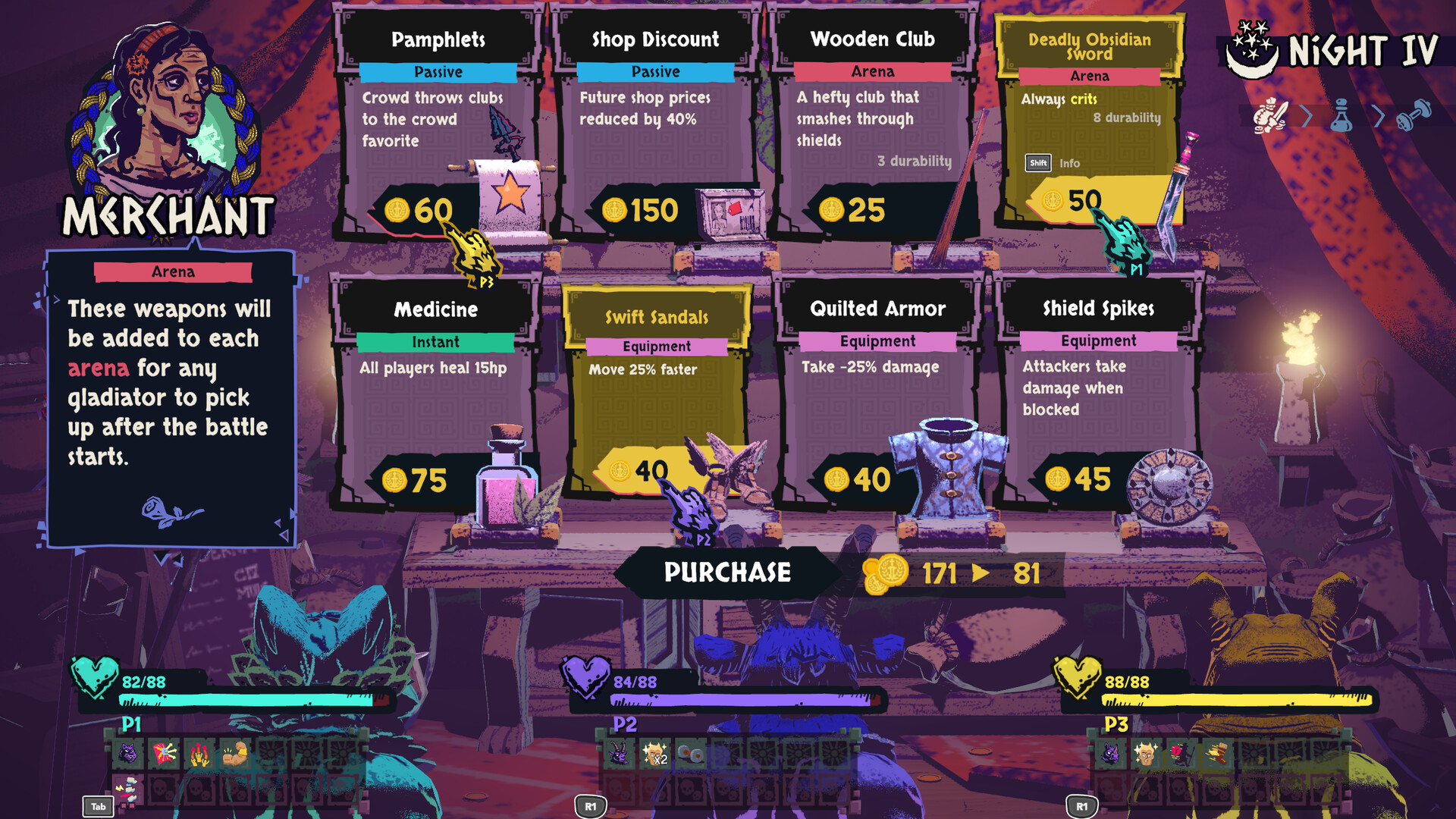
Official screenshot · Source: Steam store
Chained Beasts switch matters most when you treat each arena day as one sitting. Rising fame leads to harsher bosses who already have the gear advantage. Between rooms you collect wounds, gold, skills, and new fighters. You do not need a free evening to feel a run move. You do need a group that will talk before it sprints.
| Piece of the loop | What you are deciding | Why it suits a Switch session |
|---|---|---|
| Arena fight | Weapons, throws, hazards, who dives | One room is a clean pause point |
| Potion or water | Heal now, or skip a side effect | Fast menu, long-term cost |
| Surgery and skills | Cut a wound or gamble on a buff | Builds change between days |
| Shared shop | One buy can open for the group | A short huddle, not a wiki dive |
| Fighter unlocks | New starts and starting perks | A reason to replay after a clear |
Player experience from a pre-release 1.0 session matches that shape. Friends who had liked the demo came back with early access, played online, and used the lowest setting as a tour instead of a locked tutorial. They still went down, wrapped a pillar, and hit each other. A gentle difficulty does not turn the tether off.
Shop specifics are thinner than the combat. The Nintendo page captured with these sources stopped on an age check and did not show a price, download size, or performance mode. Nothing here confirms local split-screen, cross-play, or a handheld frame rate. What players described is online co-op, so assume one system per person until the listing says more. Confirm price, region, and the rating gate on Chained Beasts for Nintendo Switch at Nintendo.
How the Chain Changes Every Fight
Official copy says four friends can be linked in ways that punish bad spacing. Drift apart and you knot the line around a pillar. Move as a unit and you can trip someone and take the room back. Community reports show the link is not one fixed shape for a whole run.
Players in that 1.0 session saw the formation change by fight. Sometimes the whole party shared a tether and could drag each other off a route. Sometimes it was single file, and the middle player caught nets and poles while the ends kept walking. One boss tied everyone to logs that burned on contact. Another area hung the group on a heavy shared ball, and throw distance fell apart after a weak-arm affliction. Near the end the chains snapped and followed them like loose tails through a larger version of the opening grounds.
| Link players reported | What went wrong | Practical fix |
|---|---|---|
| Everyone chained | Friendly fire and pillar wraps | Split targets and call rotations |
| Single file | Middle fighter eats nets and stops | Ends lead; middle calls a halt |
| Unlinked allies | Freer spacing, same friendly fire | Throw wide, not through a teammate |
| Burning logs | Contact damage they did not expect | Park the logs away from the boss |
| Heavy shared object | Short throws, worse with a weak arm | Skip throw-nerfing afflictions |
Trips are a called play. One fighter gained vigor for tripping and had to beg the others to stop creeping so the line would clothesline the target. A separate input wraps the chain and strangles. That group ignored it until a full wrap popped an achievement for wrapping an enemy. Objectives are pickier. A task to chain-trip javelin enemies never ticked, even while bodies hit the ground. Assign one person to the bonus and have everyone else only soften.
Going down is normal. Players carried a fallen friend, and a death still paid out gold. On a small screen the hard part is losing the anchor. An affliction that hides the chain leaves you feeling a pull you cannot see. Call a stop before you lap a pillar, and haul a downed ally off the fire before the next greedy execution.
Weapons, Throws, and the Pit
On Chained Beasts switch, durability matters more than a flashy drop. Shields snap. Bows have a limited quiver. Players who tested ranged kits thought a shield could sit on the back and still not be used while aiming. That is why a pre-release group often bought passives instead of another weapon. A crit blade or an explosive is fun until it breaks, or until it deletes the ally in the arc.
Fists are a serious path. Reported pieces fit together: high punch crit chance, punches that stun, grabs on stunned bodies, and extra melee from weapons already stuck in the target when you punch again. Blocking a normal attack stunned some fighters, who then went into the fire. Executions looked briefly safe during the animation. A separate buff in that run also granted about six seconds of invincibility, so do not treat every finisher as a long shield. Players also believed a dodge kept its invulnerability frames even when a hit looked like it landed.
The arena is a third weapon. Official examples include urns, spike walls, and snakes. In play, fire, bombs, bear traps, and flail users who chopped each other did as much as swords. Throw the weapon if you must, then the enemy if you are empty. Walk a stunned target into a trap instead of trading in a clump. Traps can catch the chain, not only a boot.
| Option | Best use | Watch-out from play |
|---|---|---|
| Melee weapon | Objectives that demand a flail, spear, or similar | It breaks; do not be the only one holding it |
| Bow | Chips before the chain closes | Finite arrows; shield may not work with it |
| Shield | Block into a stun, then a grab | It breaks, and blocks still bunch the line |
| Fists plus stun perks | Grab, throw, execute, keep pressure | Crowd scoring may prefer mixed weapons |
| Hazards | Fire, bombs, traps, spikes, snakes | Blasts hit allies; traps snag the chain |
Crowd favor is the other scoreboard. Throws keep the audience loud. When a crowd passive was active and two players had the crowd going, enemies lost stamina, speed, and damage. The group was not sure a third excited player still met a “two players” line, so they played to two and moved on. A show bonus seemed to prefer mixed weapons. A pure puncher melted a late boss and still posted a weak performance score because the crowd tired of one motion. Punch for the build, and throw often enough to look like a show.
Afflictions, Potions, and Surgery
Each day adds misery. Official copy mentions a limp, a missing eye, and hallucinations only you can see. Potions take the edge off and can leave something worse. Surgery removes a curse, adds a buff, or becomes another gamble.
For Chained Beasts switch groups, water is the default, not the consolation prize. Everyone picks a potion, and you generally cannot share the downside. Players called water the exception: it can be shared, and it does not heal. It is how you opt out when the heal is not worth the curse. If your health is fine, drink it. Do not “help” by grabbing a negative you have not read.
Afflictions have a ceiling, and they rank up. A mild limp that players barely noticed later reached a point where running was gone, so the slow fighter becomes the center everyone else must orbit. Moderately shorter chains were treated as a group problem, not a private one. Hidden chains, double vision, blur, colorful distortion, and hallucinated enemies are all worse on a handheld screen. On a TV you can squint. In your hands you will miss the bomb.
| Decision | Take it when | Leave it when |
|---|---|---|
| Water | Health is acceptable | Someone is one hit from a down |
| Low-rank limp or poor balance | You need the heal and can spare speed | The next rank would kill your sprint |
| Hidden chains or heavy blur | You are docked and the alternative is brutal | You are handheld |
| Shorter chains | Almost never | The party already tangles on pillars |
| Bandages | Several people are cursed | Read who they hit; players thought the whole party |
| Extra life | A boss is next | You forget to equip it before the door |
Surgery in that session was build-defining. One result was a large crit chance on punches, stun on those crits, and more damage if weapons were already embedded. Another stunned enemies briefly as they approached and made the crowd like you more. An extra kidney reduced the punch of higher-tier affliction potions. Cash surgeries could backfire, and procedure quality mattered: a clean result stayed clean while a messy one cost health. A surgical rod was read as a block without a shield.
Cleanup is common enough to become a bad habit. Bandages cleared multiple afflictions, and the group read the effect as hitting every player. You can also scroll several ailments when choosing what to cut. After the clear, on-screen text said training too hard causes afflictions. Players had missed that workout-style risk on the easy setting and believed it matters more once you climb. Do not take every curse just because bandages saved you once.
Positive effects can be swapped, and some double if you trade into them. Fury from dodges, from every few punches, or from an ally who already has the crowd, can be extended. One loyalty-style pick sharply raised damage dealt to allies. That is a joke, not a plan, unless your group wants the joke. Read the line before you lock it.
Shop text they encountered said a single purchase becomes available to everyone. They weighed flat damage against armor that ignored the first few hits, and the better pick depends on how often you get touched. Crowd items that weaken enemies were an easy group yes. Stamina was skippable for people who were not running dry. Put a one-use extra life on the diver before the boss, and expect it to be destroyed after it fires.
Unlocks, Difficulty, and the First Clear
Win the crowd and the audience backs you. Save gold, buy gear, learn skills, and unlock fighters with their own abilities. Official copy says each run should fork. Community play shows those forks are characters as much as maps.
After a first clear, that group had a stack of new fighters. They already knew a bear. An eagle was new. A panther showed up mid-run. They tied a lion to the next difficulty and guessed the last silhouette might be a monkey or baboon. Treat that animal list as incomplete observation, not a checklist. What they trusted is more useful: leveling a fighter opens different starting perks, and the look changes too.
| Step they named | How it felt | What to do with it |
|---|---|---|
| Lowest setting (they said “pleb”) | A full 1.0 run was clearable | Learn chains, potions, and objectives here |
| Legionnaire | The next named difficulty | Expect less forgiveness and more training risk |
| Primus | The step beyond that | Use it when easy clears feel empty |
| Fighter levels | New starting perks and visuals | Pick a main after you know your role |
They finished satisfied and slightly under-hit. A day-10 finale in a bigger opening area, collaborative executions, and broken chains arrived before the game had really bruised them. That is buyer context, not a score. If you want a chaotic co-op toy on night one, the easy path delivers. If you want a run that falls apart, climb. Even on the gentle setting, afflictions swung fights more than raw enemy health.
Habits that survive the climb:
- Soften elites for the player holding the objective weapon, then leave the arc.
- Throw during crowded phases so your swing does not hit the ally between you and the boss.
- Keep a backup weapon on your body before you hurl the good one.
- Take water over a flashy curse when health is not the problem.
- On Chained Beasts switch in handheld mode, refuse vision afflictions first and chain-blindness second.
- Equip the single-use extra life before the boss door.
- Let the puncher punch. Everyone else feeds stuns, fire, and weapon variety so the crowd stays up.
Chained Beasts switch is at its best when the party treats the tether as a weapon and the potion list as a contract. The arena will not get simpler just because the screen folds. Check the live Nintendo listing before you assume the page you remember is still the current deal.
FAQ
Is Chained Beasts switch only for docked play?
No. Arena days fit handheld sittings, and online co-op does not require one couch. Dock the console when someone is stuck with blur, double vision, or a hidden chain. Those afflictions are much louder on a small screen.
How many people can play, and is it local?
Official material calls for up to four friends chained together. Community reports describe online co-op, not a confirmed split-screen mode. Unless the store page says otherwise, assume each player needs a system.
Does the first difficulty teach the whole game?
It teaches the toys. In player experience, a low setting still includes chains, potions, surgery, shops, bosses, and unlocks, and a solid group can clear it. Legionnaire and Primus are the later names they cited, and that is where training penalties should matter more.
What should a new group learn before the first boss?
Share water if you do not need healing, keep a spare weapon, and split targets so the chain does not make you hit each other. Throw stunned enemies into hazards instead of dueling in a clump. Chained Beasts switch punishes silence more than it punishes a missed swing.
Related Guides
Chained Beasts console: PS5 Co-op Gladiator Guide
Plan a Chained Beasts console run on PS5: chain co-op, arena tools, wounds, bosses, and tips before you gather a party.
Chained Beasts nintendo switch: Arena Co-op Guide
A practical look at Chained Beasts on Nintendo Switch: co-op chains, arena combat, wounds, bosses, and buying checks.
Chained Beasts ps5: Arena Guide for Players
See how Chained Beasts plays, how chained co-op works, and what PS5 players should confirm before buying this gladiator roguelike.
Chained Beasts full release date: Oct 15, 2026
Chained Beasts full release date was October 15, 2026. Check price, co-op setup, the sale window, and the update roadmap.
Chained Beasts demo: Co-op Arena Survival Guide
See what the Chained Beasts demo trailer reveals about four-player arena co-op, chain combat, risky elixirs, and a practical first-session plan.