Chained Beasts multiplayer: Co-Op Tips and Builds
Learn how Chained Beasts multiplayer chains co-op pit fighters together, plus affliction picks, shop calls, and boss tips from player runs.
Chained Beasts multiplayer turns a pit-fighter roguelike into a group problem: every swing, dodge, and potion choice can yank the whole squad. That shared leash is why the mode matters if you want co-op that punishes selfish positioning. Chained Beasts multiplayer ties allies together, then asks you to clear arenas, manage afflictions, and keep a hostile crowd entertained without friendly-firing the person on your chain.
Early footage treats it as an online co-op arena brawler with roguelike upgrades between fights. In a pre-release co-op session from Wander and friends, a four-player group on the easiest setting still spent as much time untangling themselves as they did killing enemies. The notes below come from that player experience, not from a patch-notes sheet, so treat exact perk names and numbers as community reports that can change.
What the chain changes in every fight
The fantasy is simple. You are gladiators linked by chains, fighting in a pit while the crowd scores the show. Movement is not free-form co-op. If one player sprints for a bow on the far side, everyone else feels the line. Community reports say yanking the chain does not launch a teammate farther in the way some players first expected. It mostly limits spacing, snags geometry, and forces the group to pick a direction together.
Official screenshot · Source: Steam store
That constraint creates the real skill check. Melee players want to stand on different targets so swings do not clip allies. Ranged players run out of arrows and cannot always reach a refill if the chain is short. Shields break. A shield can ride on your back while you use some ranged weapons, but player experience suggests you cannot actively block with it at the same time. Specials are easy to miss in the noise: on mouse, holding right click was the input this group used.
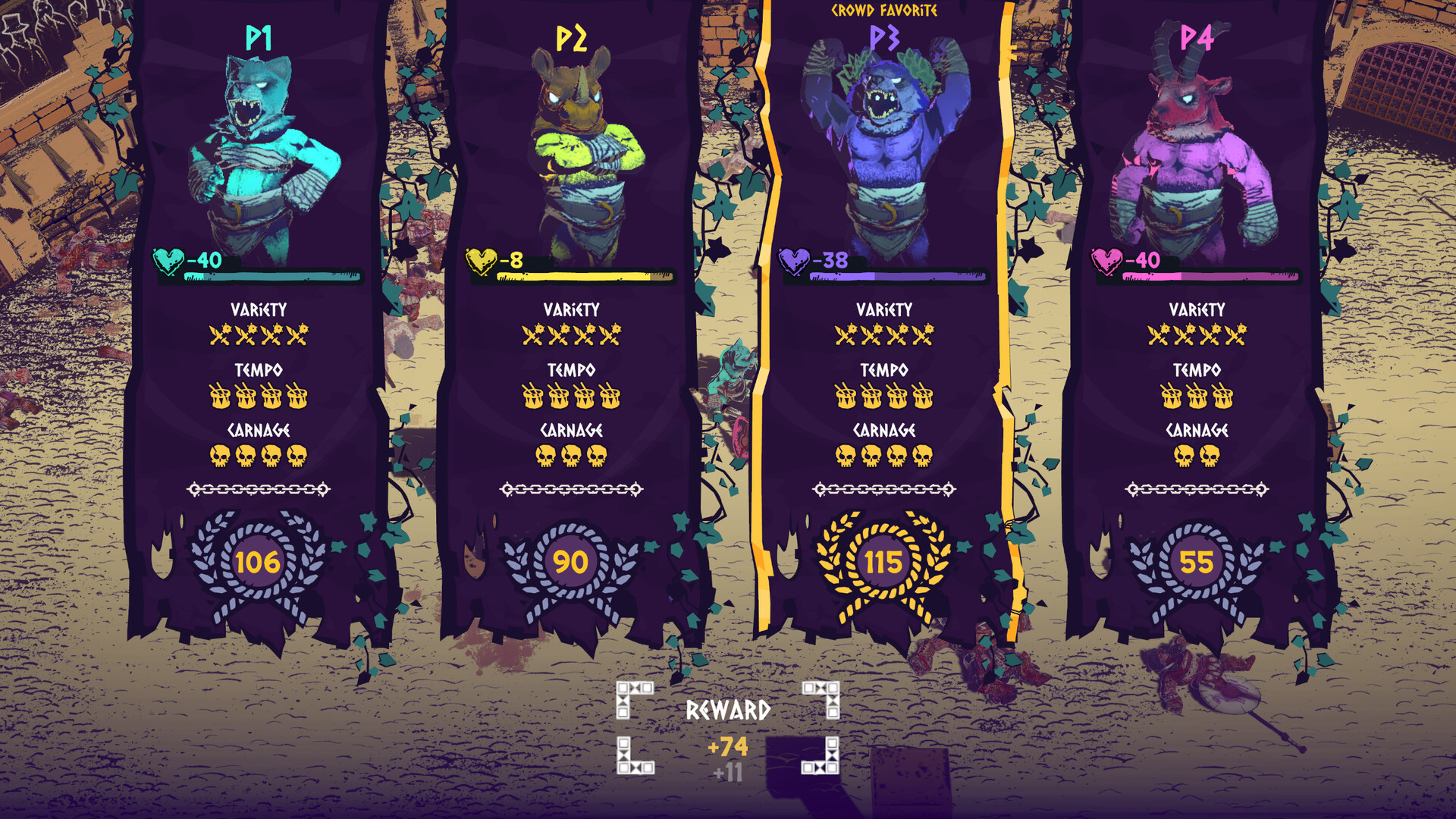
Friendly fire is constant. The same swing that trips an enemy can brain the ally behind you and shove them into a rhino. Downed players can be carried, which turns a wipe into a rescue if someone still has space to move. Dying is not a total blank, either. One downed player still walked away with a high combat score and some gold, so a bad fight can fund the next shop if the run survives.
| Chain problem | What players ran into | Practical fix |
|---|---|---|
| Pillars and poles | The line wraps and the squad stalls | Call a rotation before you commit; peel the long way around |
| Split targets | Friendly fire spikes when everyone faces inward | Assign lanes and only collapse for big enemies |
| Short or hidden chains | A "can't see chains" affliction, or shorter links, turns movement into a surprise tug | Keep a caller; do not all sprint at once |
| Nets and bear traps | Traps can catch the chain rather than the body | Slow down when traps appear; free the caught player before you greed |
| Revive carries | A downed ally has to be dragged while adds keep spawning | Clear a pocket, then carry; do not drag through the boss |
Chain tools go beyond walking. Tripping an enemy with the chain fed vigor for at least one build in this run. There is also a wrap: loop the chain around a foe and strangle them. That action popped an achievement for wrapping an enemy, and it is easy to miss if you only use the chain as a tripwire. Some contract-style objectives ask for chain trips on specific foes, such as javelin enemies. This group knocked plenty of fighters over and still did not get credit, so community reports should treat those objectives as finicky until you confirm the exact trigger.
Afflictions, water, and surgery
Between battles you drink. Healing is not a free group restore. Each player picks a potion, and negatives are personal. Water is the exception this squad could share, but it did not heal them. It was an opt-out: skip the heal, skip the curse, and live with the missing health. On a low-damage fight that is often correct. On a boss it can be greed.
Afflictions have a cap, and they can rank up. A mild broken foot barely showed as a limp. A worse rank slowed the player enough that allies had to orbit them. At the extreme, community reports say you can lose the ability to run. Vision curses are another trap: blurry short-range sight, doubled vision, colorful distortion, or hallucinated enemies. They are funny on a highlight reel and miserable when bombs are already in the air.
| Affliction style | Player-reported effect | When it is acceptable |
|---|---|---|
| Broken foot | Starts as a small slow; higher ranks can stop sprinting | Early, if you are not the scout |
| Hidden chains | You cannot see who is pulling you | Almost never in a four-stack |
| Shorter chains | The whole group loses spacing | Only if everyone agrees |
| Vision distortion | Blur, color shift, or fake enemies | If you are not on bombs or traps |
| Irritability / poor balance | Makes friendly hits or footing worse | Joke picks, not boss picks |
| Easy stackables | Mild curses you barely notice | Useful because the affliction cap is real |
Stacking curses you can ignore is a real tactic, because the cap stops you from eating every penalty. Do not stack ones that scale into a crawl. If two skulls already limp you, a third rank is a group debuff.
Surgery showed up as a new between-fight stop for players who knew the demo. You can strip a negative or gamble for a buff. One option granted a chunk of gold with a chance of a fresh affliction. Another, described as an extra kidney, reduced the severity of harsher potion curses going forward. Cosmetic surgery in this run stunned enemies briefly when they first approached and made the crowd like that player more. A "standard" procedure and a "messy" one were not equal: the messy version cost health. Hold the inspect button before you confirm. This group used Shift on keyboard and bumped into LB/RB on a controller while trying to read the tooltip.
Removal gets easier later in a run. Bandages, in this player experience, cleared three afflictions and the group believed the cleanse hit every player. That is a run-saving buy if several people are carrying vision or movement curses into a boss. There are also ways to delete a single problem, such as a broken foot, so you are not married to an early mistake.
A training or workout stop that players remembered from earlier builds did not show up on this easiest clear. Community reports guessed it returns on higher difficulties, where training too hard itself causes afflictions. If your group only knows the demo, do not assume that beat is gone forever.
Shop calls that do not waste the purse
Gold is shared pressure, not a private wallet. The rule this squad hit was blunt: buy an item once and it becomes available to everyone. That makes the first purchase a group vote. Passives sat at the top of their list because weapons break. A shiny crit sword or explosive looks strong until durability dumps it mid-wave, and explosives are an easy way to delete a teammate.
| Buy | What the group understood | Co-op verdict |
|---|---|---|
| Group heal or medicine | Tops everyone up before curses stack | High priority after a sloppy fight |
| Flat damage (about +20% in this run) | Straight damage with no setup | Take it if the alternative is a weapon you will break |
| Armor plates | Ignore the first three hits | Better for players who get tagged often |
| Percent damage reduction (about 25%) | Always on, but smaller per hit | Better if you rarely get hit |
| Crowd horns | Enemies lose stamina, speed, and damage if two players have the crowd going wild | Strong if your builds already farm crowd meter |
| Bandages | Remove multiple afflictions | Emergency button before a boss |
| Extra life | Must be equipped before combat; destroyed after one use | Give it to the player who soaks the boss |
| Stamina gear | More swing uptime | Skip if nobody is running dry |
| Fragile weapons | High upside, low durability | Usually a trap versus passives |
Armor plates versus a percent reduction is a math argument, not a vibe. Plates delete whole hits, so they win if you eat big attacks and then play clean. A 25% cut wins if you are going to get tapped all fight. You often cannot buy both without selling something else. Drop stamina first if the group is not bottoming out.
One-time defensive pickups can respawn each fight while only one player can hold them, based on how this run talked through the choice. Do not double-grab. Decide who is eating the next boss.
Crowd management is a hidden economy. Throws make the audience happy. An ally perk can copy "crowd going wild" if someone else has it and you do not, and that buff runs on a timer. Horns that weaken enemies asked for two players with the meter up. The group was not sure a third player would still satisfy an "exactly two" check. Until that is confirmed, have two designated showboats rather than assuming more is better. MVP-style bonus damage favored weapon variety over a fists-only game. Extra gold did not itself grant MVP. If one player is the punch specialist, someone else should rotate weapons so the squad still cashes the crowd.
Builds that actually cooperate
Four players see more perk options than a duo, and this group said that out loud: begging works when the pool is wide. The strongest story in the clear was a punch build that stopped needing a main weapon.
Drive it Home, as they described it, makes a punch trigger extra melee damage from every weapon already stuck in the target. Embed, then punch, and the pincushion pays twice. Surgery layered a reported 30% crit chance on punches, with crits that stun, plus the right to pick stunned enemies up. Punching an embedded foe hit even harder. Later, every third punch granted fury for a few seconds, and swapping a copy of that effect doubled it. With momentum and stun chance stacked, they talked about roughly a coin-flip stun on punches. That is community-reported build math from one run, not a guaranteed rate.
The loop is filthy in co-op and also teammate-dependent:
- Allies throw or stab weapons into a target and back off.
- The punch player blocks a normal attack to stun, or stuns on the punch itself.
- Stunned bodies get picked up and thrown into fire, bombs, or other hazards.
- Executions add a short window of slight invulnerability. Use them on elites, not on trash you can throw.
- A six-second invulnerability window, once it procced, was enough for that player to brute-force a boss while everyone else handled adds.
Blocking once stunned the spinning fighters in this run. Shield breaks also seemed to stun. Blunt weapons were the group's best guess for other stun sources, but they were not certain. If your punch player is the carry, do not hand them Weak Shoulder. That curse undercuts the throw follow-up that makes stun worth taking.
| Role | Job in the pit | Perks that matched in this run |
|---|---|---|
| Punch carry | Stun, pick up, throw, execute | Embedded-weapon punches, punch crits, fury on every third hit |
| Throw support | Keep weapons in bodies and the crowd meter high | Crowd-on-throw, fury generation, weapon variety for MVP |
| Trip caller | Chain-trip for vigor and set up executes | Chain trip, longer stuns, pickup on stun |
| Anchor | Block, hold elites, get carried less | Armor plates, extra life, block-without-shield later |
A later surgery result gave a block even without a shield, which turned the punch player into a monk who could still answer a heavy. Executions were easy to forget; one player admitted they had only landed one for a long stretch. Put them on a voice call. "Execute" should be as routine as "behind you."
Loyalty showed up as a listed "75% damage to allies" option. The group treated it like a friendly-fire modifier and joked about hitting each other on purpose. Another perk made hitting an ally grant that ally fury and the attacker vigor. On a punch carry, a light slap to the back of the head can be a buff, not a mistake, if you are sure of the tooltip. Read it. Do not discover the friendly-fire number during the boss.
Fury also came from dodging for at least one player, and dodge appeared to keep full invulnerability frames even when the dodge visually overlapped a hit. That is a player observation from a messy fight, so test it yourself before you face-tank.
One objective told a player to miss exactly 15 attacks. Missing more ruined it, and getting the misses early was dangerous because later waves still needed real swings. The workaround was embarrassing and effective: miss the quota, then block and let allies work. Another player literally got picked up and carried so they would not swing. If your contract is that precise, assign it to someone who can stand still.
Arenas, bosses, and what unlocks next
On the lowest difficulty, which the group called pleb, the first full clear felt too smooth once builds came online. They still almost died in bomb waves, rhino traffic, and fire. The rhino in one arena did not have to die. It wandered, trampled anyone in the lane, and the real job was the adds. A later arena with a ballista and much higher enemy health was still easier, in their words, than the bomb biome.
Boss structure changes the chain. One fight attached logs to the party. The logs could not be thrown, they caught fire, and touching them burned. Adds spawned while the boss focused one player, which is the window for everyone else to breathe and deal damage. Invulnerability and an execution were the finishers, not a single perfect dodge.
A late stretch broke the chains entirely. Players described chain tails, a bigger version of the opening area, and a day-10 door. Senators in that finale were almost helpless and threw scrolls, while elites and bear traps did the work. Traps snagged chains. One kill required a collaborative execution. The tone is still co-op even after the leash comes off: you are finishing a show together, not soloing a dungeon.
| Stage beat | What this run actually did | Group habit that helped |
|---|---|---|
| Early linked pit | One chain, shared weapons, first afflictions | Split targets; soften elites for the flail or spear user |
| Rhino lane | Rhino wanders; adds are the objective | Throw during messy movement so you do not clip allies |
| Fire and bombs | Spinning foes stun on a block; hazards do your damage | Throw stunned bodies into fire; call bombs |
| Log boss | Immovable burning logs plus adds | Kite the boss onto one player; others clear adds |
| Unchained finale | Higher health, traps on the chain, senator set dressing | Save extra life and plates for the door, not the trash |
Character unlocks were the reward for finishing, not just the clear itself. The group came out with more fighters, including a bear some of them had seen before and an eagle that felt new. Higher difficulties were labeled Legionnaire and then Primus. They expected a lion on the Legionnaire track and guessed the last silhouette might be a monkey or baboon. Leveling a fighter changes starting perks and, in this player experience, changes how the character looks. That is the replay hook after an easy first clear: the roguelike layer is the roster and the curse load, not a single story door.
They also thought later biomes were available without winning a previous run. That was a guess at the start of the session, and the run did move through multiple arenas on a first 1.0-style attempt. Do not plan a route around locked worlds until you see the select screen yourself.
Difficulty still matters because negatives scale the run more than raw enemy health did on pleb. The same potion table that is a joke at low rank becomes a movement disable later. If the first clear feels short, raise the tier before you decide the game has no teeth. Players who knew the demo specifically missed the training risk-reward on this difficulty and wanted it back as a feature, not as a punishment toggle.
Co-op habits worth stealing
Use a single caller for direction. "Left" means the chain moves left. Two people picking opposite shields is how you wrap a pillar and eat a bomb.
Assign loot before the doors open. Shield, bow, flail, and spear should not be a scramble. One player only can complete some weapon challenges, such as three flail kills, so the squad should soften targets and let that player take the last hit.
Put the extra life on the person who will be inside the boss, and equip it before the fight. It does not fire automatically, and it is gone after one use.
Prefer passives over brittle weapons once gold is tight. Damage, plates, crowd horns, and bandages all outlived the gear this group kept breaking.
Keep one stun specialist and one variety fighter. The punch build deletes elites. The variety fighter keeps MVP and the crowd meter from being a one-person hobby.
Save water for curses you refuse, not for every room. A small health deficit is cheaper than blurry vision in a bomb wave.
If a contract says "exactly," stop the moment you hit the number. Extra misses, extra trips, or extra kills can fail the ask.
Voice the chain. "I'm stuck," "log is on fire," and "execute together" are the difference between a clear and a highlight of four people spinning around a pole.
Chained Beasts multiplayer rewards groups that treat the leash as a weapon and a liability at the same time. Throw bodies, embed weapons, trip with intent, and buy the cleanse before you buy the sword. The first easy clear is a tutorial. Legionnaire is where those potion choices start to matter.
FAQ
Is Chained Beasts multiplayer online, and how many players showed up?
Yes. The mode is online co-op, and the player experience here was a four-person pit. More players meant more perk choices between fights, which made specialized builds easier to assemble.
Can you heal the whole party with one potion?
Not in this run. Each fighter picked their own potion, and water could be shared but did not restore health. It only opted out of a curse. Group healing showed up as a shop or item decision, not as a shared sip.
Do you stay chained for the entire run?
No. Early and mid fights used links, sometimes one chain and sometimes awkward attachments like burning logs or a shared heavy ball. A late finale broke the chains and left the group moving freely, with traps still able to catch a chain before that break.
What difficulty should a new group pick?
Start on the lowest tier if you are learning chain spacing, stun throws, and affliction caps. This squad cleared it and found the enemies forgiving once a punch build came online. Move to Legionnaire when you want harsher curses and the next character unlocks, and treat Primus as the tier after that.
Related Guides
Chained Beasts coop: Chains, Builds, and Team Tips
Chained Beasts coop explained: chain layouts, afflictions, shared shops, punch builds, and team tips from early player runs.
Chained Beasts couch co op: local play guide
Player-tested look at Chained Beasts couch co op: chains, crowd scores, shared gold, afflictions, and local multiplayer tips.
Chained Beasts crossplay: Who Can Play Together
How Chained Beasts crossplay works for 1-4 player co-op, which PC platforms connect on Steam, and how couch play fits in.
Chained Beasts full release date: Oct 15, 2026
Chained Beasts full release date was October 15, 2026. Check price, co-op setup, the sale window, and the update roadmap.
Chained Beasts Steam Deck: Status, Controls, Tips
Chained Beasts Steam Deck support is still Unknown. See controls, co-op limits, launch price, and how to test the demo on handheld.