Chained Beasts crossplay: Who Can Play Together
How Chained Beasts crossplay works for 1-4 player co-op, which PC platforms connect on Steam, and how couch play fits in.
Why the chain only works if the party can connect
Getting four gladiators into one arena is harder than landing a chain throw when everyone owns the game on a different computer. Chained Beasts crossplay is the feature that decides whether a Windows player and a Mac player can share that chaos, or whether the party has to pile onto one couch. Three days after the October 15, 2026 launch, Featherweight Games is selling the roguelike as a 1–4 player co-op brawl, and the Steam listing explicitly includes cross-platform multiplayer. If your group is split across operating systems, Chained Beasts crossplay is the first thing to verify before you buy a second copy.
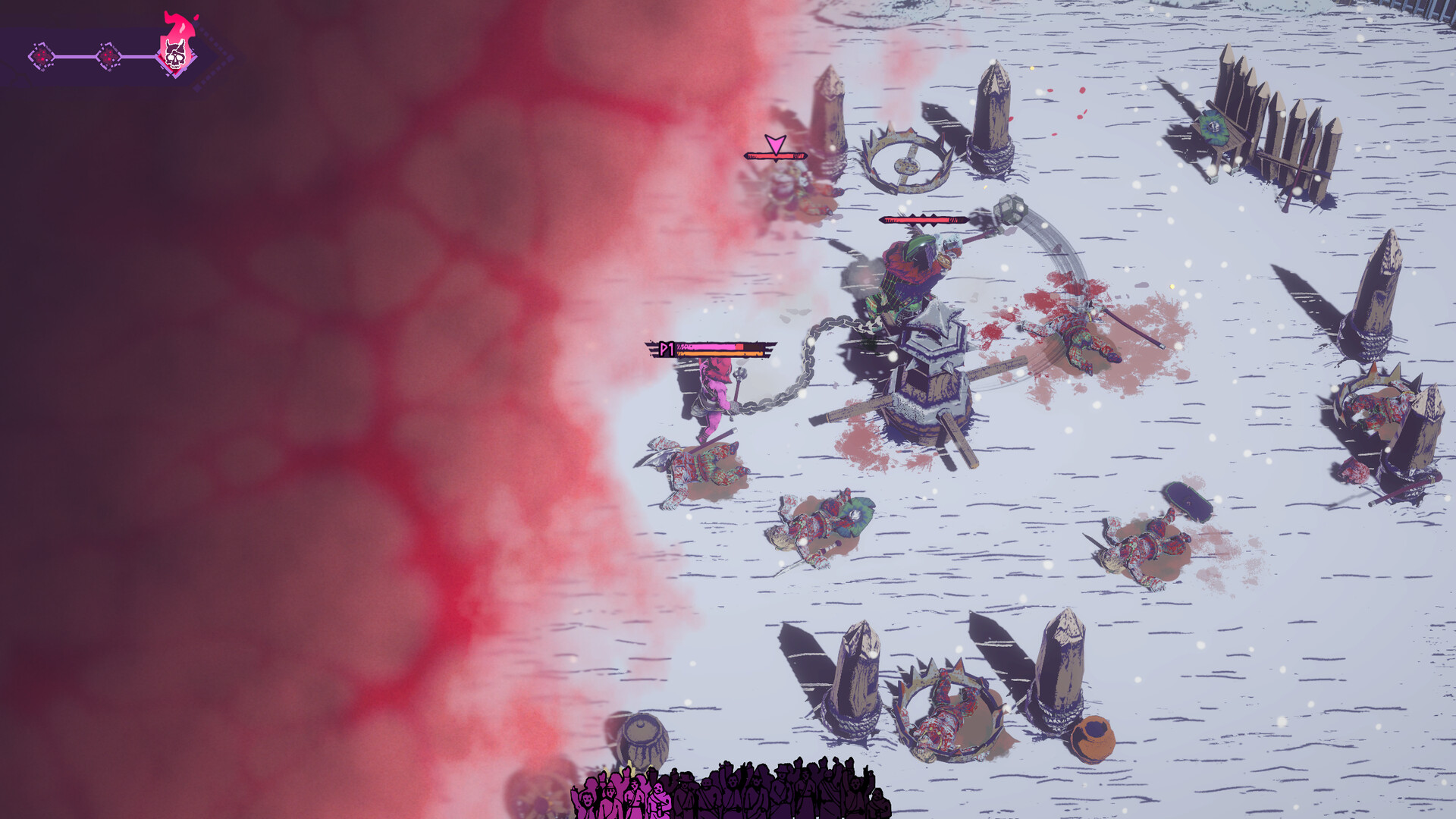
Official screenshot · Source: Steam store
The studio’s own launch note tells players to fight alone or online with friends using online cross-play, or to stay home and use couch co-op. Steam also badges the game for online co-op, shared and split-screen co-op, and Remote Play Together. That is a real multiplayer stack, not a single vague “multiplayer” tag. It is also narrower than a lot of players hope. Nothing on the store page or in the launch posts lists a PlayStation, Xbox, or Switch version. The published system requirements cover Windows and macOS only.
This matters because the fantasy is physical. You are literally linked. Miss a call and the chain wraps a pillar. A missing fourth player is not a smaller damage bonus. It changes how the chain behaves.
What the store actually promises
The short version of Chained Beasts crossplay is PC-to-PC co-op on the Steam release, not a console network. Featherweight, which developed and published the game, describes it as a co-op gladiator roguelike for one to four players. The October 15 store announcement says to grab up to three friends. A community launch post uses the looser line “up to four friends.” Until the studio publishes a stricter cap, plan on four people in the arena total. That reading matches the product page.
Steam’s feature row is the best public spec:
| Feature on Steam | What it implies for a group | What it does not prove |
|---|---|---|
| Online Co-op | Separate players can join one PvE run | A public matchmaking queue |
| Cross-Platform Multiplayer | The build is labeled for cross-platform play | Console, mobile, or other-store support |
| Shared/Split Screen Co-op | Local players can share one machine | That local players can fill an online lobby from two PCs without a host plan |
| Remote Play Together | A Steam host can stream a session to friends | That every friend is running a native client |
| Single-player | You can learn the arena alone | That solo unlocks always match party unlocks |
The launch post also points people at the studio Discord to find “chain-mates” for cross-platform co-op. That is an invite-your-friends model. Community reports already ask for automated cross-platform matchmaking, and one hub comment calls it the best way to keep the roguelite alive. Matchmaking is not on the published post-launch roadmap. Treat random queueing as unavailable unless Featherweight says otherwise.
Early reception is strong for a game that has been out for days. The Steam store shows Very Positive reviews, with 82% of 390 purchaser reviews in the positive column. Around the October 18 capture of the community hub, the page listed 2,454 players in-game. Those are snapshots, not lifetime peaks, but they show people are already trying to fill parties.
Price is part of the decision. The list price is $19.99. An introductory 35% cut brings it to $12.99, and the store says that offer ends October 29. Bundles with Gang Beasts, Cult of the Lamb, and LORT are also on the page if your group buys together. Check the Chained Beasts listing on Steam before you assume the discount is still live.
Platforms, specs, and open questions
Groups researching Chained Beasts crossplay should separate three ideas that store pages often mash together: controller support, operating-system support, and a console edition.
Xbox and PlayStation controllers are supported, and Featherweight recommends a controller. That is input support on PC. It is not evidence of an Xbox or PlayStation build. Steam Deck compatibility is listed as Unknown, so a Deck player should not be your planned host until Valve or the studio updates that status.
| Spec | Windows minimum | macOS minimum |
|---|---|---|
| OS | Windows 10, 64-bit | macOS 11 |
| CPU | Intel Core i5-5257U, AMD Ryzen 3 1200, or equivalent | Apple M1 or Intel i7-8850H |
| Memory | 8 GB RAM | 8 GB RAM |
| Graphics | GeForce GTX 1050, AMD RX 460, or equivalent | Apple M1 or Radeon Pro 560X |
| Local co-op note | At least one gamepad for same-screen play | At least one gamepad for same-screen play |
Recommended Windows and Mac specs on the store page are thin. The page mostly restates that you need a 64-bit OS on Windows and then stops. If someone is on an older laptop, judge them against the minimum row, not against a missing recommended GPU.
A few questions players are already asking do not have a published answer:
| Question from players or the page | Status in public materials | Practical assumption |
|---|---|---|
| Can Windows and Mac share a lobby? | Cross-platform multiplayer is badged, and the studio says online cross-play | Yes, plan on it for the Steam PC builds, then test once before a long night |
| Can two local players on one PC join two local players on another? | A community thread asks “4 Players Online: 2 Players on Each PC?” | Unconfirmed. Do not promise a 2+2 setup |
| Is there cross-platform matchmaking? | Requested in community reports; not in the roadmap | Use friends, invites, or the studio Discord |
| Do chains physically knot around poles? | Official copy says a bad team tangles around a pillar; a player asked if the chains have physics | The tangle is part of the design pitch; exact physics limits are not documented |
| Is Steam Deck in the crossplay pool? | Compatibility: Unknown | Treat Deck as unverified |
Family Sharing is on the feature list. It is not a plan for four households. Online co-op expects each remote person to launch the game. Same-screen play is the mode built for one living-room PC. Buy a copy per machine that will run its own client.
Language support is broad enough for mixed regions. English has full audio plus interface and subtitles. French, Italian, German, Japanese, Korean, Brazilian Portuguese, Simplified Chinese, Latin American Spanish, Traditional Chinese, Russian, and Turkish have interface and subtitles without full audio. A cross-platform party can share text even when voice chat carries the tactics.
Couch, online, and Remote Play are different nights
Same-screen co-op is not a fallback for failed cross-play. It is a separate way to play, and several community reports are about that on purpose. One player said they run couch nights often and do not care about solo or online. The store’s extra note is blunt: same-screen co-op needs at least one gamepad.
| Way to play | Copies you should plan on | Hardware that matters | Where it breaks down |
|---|---|---|---|
| Solo practice | 1 | Controller recommended | You never learn chain spacing with real people |
| Couch / split screen | 1 on the host PC | 1+ gamepads; a readable TV | Four-player UI and camera effects get messy up close |
| Online co-op | 1 per PC | Stable connection; voice chat | No documented public queue |
| Remote Play Together | 1 host copy, friends stream in | Host upload and the host PC | Input delay on a game about spacing and throws |
Remote Play Together is Steam’s streaming feature, and the store lists it. Friends join your session without each running a full local simulation the way native online co-op does. Use it when someone cannot install the game, not as your first choice for a precision chain pull. The combat asks you to throw weapons, charge people into spikes, or dump them into a snake pit. Extra stream latency makes those reads worse.
Native online play is the mode Chained Beasts crossplay refers to. Each player runs the client. The chain is the teamwork test Featherweight kept returning to. Co-director Tim Kaldor has said the revived project leaned harder into the chaos and comedy that chains and injuries create in a four-player group, while still aiming for punishing gladiator combat. The studio calls the result a hardcore party game.
That design punishes silent parties. Official copy says an uncoordinated team ends up wrapped around a pillar, while a synchronized team can trip enemies with the same chain. Voice comms are not optional flavor. Agree on simple calls: “slack,” “pull,” “pillar,” and “drop the weapon” cover most of the early disasters.
How shared injuries change a cross-platform party
Cross-play would matter less if this were a standard hack-and-slash where everyone farms in a corner. Healing is a bargain. Between rounds you take an affliction to recover. The studio says there are more than 70 of them, mixing physical and mental problems, and that difficulty is not only “more hit points on the enemy.”
A few afflictions shown for launch are social by design:
- Annoying makes allies tend to attack you if you stand too close. In a chain, close is the default.
- Impulsive locks a new skill every second level and forces a shop purchase even when you wanted to save.
- Infatuated sticks your camera to one ally and gives you 10% more damage while they are looking at you.
Player experience backs up how wild the list gets. One reviewer described small curses such as colorblindness or dropping a weapon, and run-ending ones such as losing arms or staying on fire. Another stacked Far-Sighted and Near-Sighted until only a thin band of vision stayed clear. Friends named it “bagel vision,” and that player still won the round as the useless fighter in the middle. A third review called the risk-reward loop the highlight: grind one more level and accept being blind in one eye, or heal to full and lose a toe that makes you trip when you sprint. That reviewer also said unique multiplayer afflictions make the choice better, and that a strong run is mostly about becoming more overpowered than you are nerfed.
There are 10 difficulty levels. The same player experience says each step adds some mechanics plus tougher, more numerous enemies, rather than a brand-new game. Solo, they expected a fantastic 10–15 hours before shops started repeating, with more time if you keep queuing with friends. For the sale price, they still recommended it.
For a remote group, read every affliction out loud before anyone accepts it. Infatuated is a camera problem the other three cannot see. Annoying is a friendly-fire problem the chain will make worse. Impulsive can spend money the party thought was reserved for a weapon. The store also describes limps, a missing eye, and hallucinations only you can see. Those are funny on a couch because everyone can look at one screen. Over cross-play, the afflicted player has to narrate them.
Progression sharing is the sore spot in early community reports. One detailed negative review still called it a great game with friends, then withheld a recommendation because a challenge unlock went only to the person who completed it. The example was a Rhino beast landing the kill on the first boss: the outfit unlocked for that player, not for the people who helped, so a full group would repeat the run. The reviewer noted that a developer replied. Do not treat that as fixed. If your reason for buying is shared cosmetics, confirm the current unlock rules in the latest patch notes before you split the party across four PCs.
The campaign itself is built for repeat nights, not one sitting. Launch materials lay out this scope:
| System | Launch figure | Why a co-op group cares |
|---|---|---|
| Structure | 9 battles across 3 acts, then a final encounter | A full clear is a session plan, not a 20-minute match |
| Difficulty | 10 increasingly harsh levels | You can replay with the same cross-platform crew |
| Afflictions | 70+ | Heals change how the chain has to move |
| Skills | 70+ | Builds diverge even on the same beast |
| Items | 40+ | Shops are a real stop, not a menu skip |
| Roster | 8 beasts, plus variants, stats, abilities, and cosmetics | Someone can fill a role the party is missing |
| Achievements | 60 on Steam | Party challenges may not credit everyone |
Eight beasts and their variants give a group a reason to swap hosts and characters. The store pitch also says crowd favor, purchased gear, and new skills can turn a fight, and that each run asks for a different path. Bosses are framed as arena heroes with the advantages stacked in their favor. Victory moves you toward Rome, freedom, or revenge. None of that requires a spoiler sheet. It does require the same four people to show up with working clients.
Combat stays readable in a top-down hack-and-slash. You slash, throw urns, throw enemies into urns, and launch people into spikes. Weapons can be thrown, which is a bad idea if you do not have a backup in hand. Blood sprays stay in the arena. That is the mature-content note: visible blood, not a separate online mode.
The project’s history explains the co-op focus. Featherweight says Chained Beasts began about 12 years ago as a 48-hour jam called Enterchained, sparked by the chained prisoners in the movie Gladiator. The team shelved it after roughly six months, then rebuilt it once they could lean into four-player chain comedy. Co-director Dylan Bevis credited beta and demo players with cutting afflictions that felt miserable and cleaning up confusing co-op interactions. If you played the demo, the full game adds beasts, arenas, afflictions, weapons, modes, and progression on top of that foundation.
A setup that survives a weeknight
Before you rely on Chained Beasts crossplay for a scheduled night, run a ten-minute lobby test. Connect one Windows player and one Mac player, walk until the chain is taut, wrap a pillar on purpose, then drop and pick up a weapon. If that works, add the third and fourth. If it fails, you still have couch co-op and Remote Play Together as documented alternatives.
Use this order:
- Confirm every online player is on the Steam PC version, Windows 10 or macOS 11 or newer, and meets the 8 GB minimum.
- Put controllers in the couch pile. One gamepad is the floor for same-screen, and the developer prefers pad play in general.
- Skip any plan that depends on a console friend, a verified Steam Deck, or a public queue. Those are not in the current materials.
- Pick a voice channel before you launch. Chain calls matter more than build talk.
- Decide who is allowed to accept a heal. Afflictions are chosen, not random lightning, so the party can refuse a bad trade.
- Name a banker. Impulsive can force a purchase, and early player experience treats shop choices as part of the power curve.
- Rotate who plays the beast tied to an unlock if community reports about individual credit are still accurate. Do not assume a Rhino kill outfits the whole lobby.
- If someone is under the GTX 1050 or RX 460 class, let them sit on the couch instead of hosting.
That is why Chained Beasts crossplay is more than a checkbox. The game is at its best when four people share one bad decision. A solo player can still suffer 70 afflictions and learn 70 skills, but the chain gags, the friendly-fire curse, and the camera that follows someone else only exist because someone else is in the run.
The roadmap keeps those friends relevant. On October 12, Featherweight posted the near-term plan:
| When | Planned addition | Multiplayer impact |
|---|---|---|
| October 15, 2026 | Launch | Co-op, couch play, and advertised online cross-play go live |
| December 2026, update 1.1 | New arena, boss, weapon, and enemies | Same crew gets a new room to tangle in |
| Q1 2027 | PvP, plus more skills and afflictions | Friends become opponents, not only chain-mates |
| After PvP | More acts, beasts, variants, cosmetics, driven by what players ask for | Replay value for groups who have seen the shop pool |
PvP is the line to watch. A versus mode in early 2027 only helps a split friend group if the same cross-platform sessions still work when you are trying to hurt each other. The studio said it will watch what players want after that, and extra acts or beasts are the obvious campaign follow-up. Wishlist talk of about 200,000 players was a pre-launch studio figure, not a promise of populated matchmaking.
If your group is on the fence this week, the useful test is small. Buy during the intro sale if the October 29 end date still shows, clear one act online, and see whether the chain feels like a toy or a problem. Early reviews say the quality is there and the variety will thin. The people who will feel that limit last are the ones who can actually get four PCs into the same arena.
FAQ
Does Chained Beasts crossplay include PlayStation or Xbox?
No public Steam material says it does. Controllers from those brands work on PC, and the store tags Cross-Platform Multiplayer, but the only system requirements listed are Windows 10 and macOS 11. Plan on PC-to-PC play between those versions. Treat consoles and Steam Deck as unsupported or unknown until the page changes.
How many players can share one run?
The store sells a 1–4 player game and tells you to bring up to three friends. You can play solo, on one couch, or online. A community question about two local players on each of two PCs is not answered in the official posts, so do not count on a 2+2 online layout.
Is there matchmaking for cross-platform co-op?
Not in the current roadmap or feature list. The studio tells players to grab friends or find chain-mates through Discord. Community reports are already asking for an automated cross-platform queue. Until that exists, sessions are invite-based.
Do couch co-op and online cross-play use the same rules?
Both sit inside the same roguelike: shared chains, boss runs, and afflictions you accept in order to heal. Couch play needs one machine and at least one gamepad. Online play needs a copy per PC. Remote Play Together is a third option, streaming from the host, and it is a poor substitute when timing a throw matters.
Related Guides
Chained Beasts coop: Chains, Builds, and Team Tips
Chained Beasts coop explained: chain layouts, afflictions, shared shops, punch builds, and team tips from early player runs.
Chained Beasts couch co op: local play guide
Player-tested look at Chained Beasts couch co op: chains, crowd scores, shared gold, afflictions, and local multiplayer tips.
Chained Beasts local co op: Couch Run Guide
Chained Beasts local co op guide covering roles, chain callouts, crowd score, shared gold, and affliction picks.
Chained Beasts full release date: Oct 15, 2026
Chained Beasts full release date was October 15, 2026. Check price, co-op setup, the sale window, and the update roadmap.
Chained Beasts console: PS5 Co-op Gladiator Guide
Plan a Chained Beasts console run on PS5: chain co-op, arena tools, wounds, bosses, and tips before you gather a party.