Chained Beasts couch co op: local play guide
Player-tested look at Chained Beasts couch co op: chains, crowd scores, shared gold, afflictions, and local multiplayer tips.
A shared screen gets loud fast when one bad throw hits your partner instead of the enemy. Chained Beasts couch co op leans into that chaos: gladiators share an arena, a gold pile, and often a literal chain. Anyone planning a Chained Beasts couch co op night should know the tutorial is short, the crowd is picky, and healing can stick you with a permanent drawback. According to a recorded two-player session, the run starts in a Roman prisoner camp, turns the pair into arena fighters, and keeps score on carnage, damage taken, and how wild the crowd gets. That mix of slapstick friendly fire and build crafting is why a local session feels different from a typical online roguelike.
The notes below come from that recorded two-player Chained Beasts session. Treat specific numbers as player experience from one clear, not as a full patch-notes list.
What a Chained Beasts couch co op run actually feels like
You are not two free-roaming heroes who happen to share a lobby. Early on you are prisoners chained together, then branded as arena beasts who have to entertain a crowd while staying alive. The tether is the whole joke and the whole tactic. Stand too far apart and you get yanked. Stand in a throw line and you become the projectile. In a couch session that reads instantly, because you can see the same mistake at the same time.
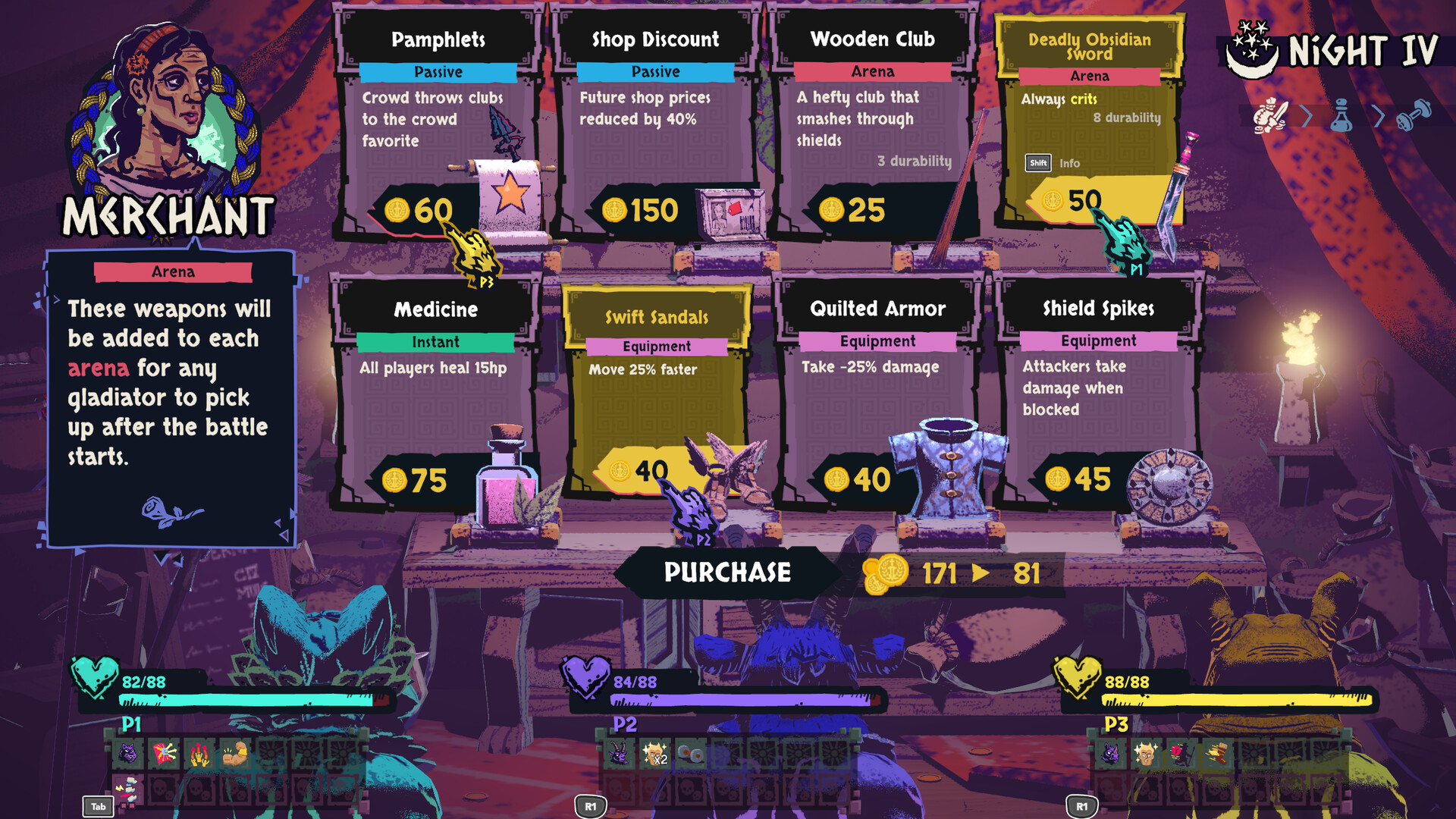
Official screenshot · Source: Steam store
Player experience from the clear describes a full arc: a prison break that fails, gladiator battles, side jobs, a surgeon who will happily remove organs, travel toward Rome, a rebellion beat, and a last push at an emperor guarded by senators. Some fights chain you to each other. Some leave you loose. One boss fight tied them to logs. Later enemies could grab the chain or drop traps that chained them again. Shared-screen co-op stays readable because the arena, not a minimap, is the puzzle.
After the clear, the same session unlocked a harder Legionnaire track and reported that Carthage stopped being the easy route. Training too hard can itself cause afflictions. They also said the game can go up to four local players. That last point is community reporting from the menu they were looking at, and four bodies on one chain would be even louder than two.
Pick roles before the first arena
The opening pair in that run was Rhino and Ibex. Rhino is the wall: shields last twice as long and damage taken drops by 30 percent. Ibex is the mover: faster travel, and dodges spend less stamina. Those two kits split a couch team cleanly. One player blocks and farms fury. The other throws, trips, and feeds the crowd variety.
You can present as male or female, and you can recolor your fighter. You cannot match your partner's color. If you try, the game force-changes someone. Outfits exist, but they are challenge rewards rather than free cosmetics. One outfit teaser in the session asked for a no-damage clear in Carthage, which the Rhino player immediately failed by taking hits.
| Gladiator | What the session reported | Best couch job |
|---|---|---|
| Rhino | Shields last twice as long; 30% less damage taken | Block, hold the line, trigger fury |
| Ibex | Faster movement; cheaper dodges | Throw, trip, chase archers, play for the crowd |
| Wolf | Dismemberment hits with body parts deal 200% damage | Prop and gore variety after Act 1 |
| Panther | More damage, less health, +50% special-attack damage | Burst windows, not face-tanking |
| Bear | More health, less move speed, fury after you get hit | Short trades, then punish |
| Eagle | Powerful throw after a melee kill | Throw builds that finish in melee first |
Wolf showed up after Act 1. Panther, Bear, and Eagle appeared later as unlocks or reward bodies, not as the starting roster. The players said a clear unlocked four characters with two still locked, and that their used fighters were only partway to level 2. Do not treat the table as a complete character list.
Learn the shared combat loop
The tutorial teaches a small set of verbs, then immediately lets you misuse them. Pick up shields and weapons lying in the sand. Block, but accept that shields break and that some hits are not blockable. Dodge and charged attacks spend stamina, so swinging on empty is how you eat a spear. Throw weapons by aiming. You can also punch, carry a partner, and throw that partner into trouble or out of it. Downed enemies can be executed. You can hit each other. That last rule is not a bug.
Crowd scoring sits on top of the brawl. Player experience describes the audience moving from angry to bored to content to wild if you vary the show: throws, traps, different weapons, smashing someone with a prop, even beating a fighter with a severed limb once Wolf's dismemberment bonus is in play. A recap compared carnage, points, and damage taken. One player can "win" the crowd while the other wins the kill count. Both matter, because wild-crowd bonuses and favorite-of-the-crowd drops showed up as real rewards later.
| Action | Why it matters | Couch callout |
|---|---|---|
| Block | Buys time; some blocks grant fury | Say when the shield actually breaks |
| Dodge | Avoids what blocks will not stop | Watch stamina, especially on Ibex jobs |
| Throw | Ranged kill, crowd variety, job credit | Never stand in the lane |
| Trip / chain | Sets up crits, fury, and squeeze kills | Mobile player should do the looping |
| Execute | Confirms a down | Ask before you steal the last hit |
| Ally throw | Rescue or attack when the chain is tight | Only if they are already down or stuck |
Fury was described in the session as about 50 percent more damage. The Rhino player built toward it on purpose: successful blocks granted a few seconds of fury, so a boring shield kit suddenly deleted elites. The Ibex player stacked crit chance instead, starting from a 20 percent all-attack crit skill and later taking a skill they called roughly a 40 percent base crit chance. A throw-kill crit guarantee was less attractive once crit was already high. That is a useful split. Do not both buy the same "I press block" talent if only one of you is holding a shield.
Chain kills are fussier than the prompt makes them sound. A job asked them to loop the chain around an enemy and squeeze until that enemy died. Squeezing popped an achievement but did not finish the job. Walking away from the wrapped target cut the fighter apart and completed it. If one partner has a wound that punishes movement, the other partner has to do that lap. Archers, nets, and fire make the lap worse. Call the wrap before you start it.
Spend shared gold with a plan
Gold is shared. A purchase can be equipment for one fighter or a permanent arena unlock that every gladiator can use afterward. That is the economic heart of local co-op: a selfish buy still sits in a shared wallet. In the session they often had one equipment slot each, so buying two weapons for the same person was waste.
Between fights you also get jobs. One offer paid 60 gold if a single player killed exactly three enemies with throws. Extra kills would fail it, and failure was threatened with a cane-level affliction. The UI would not let the second player take the contract. They set the victims up together: one lowered health, the other landed the three throws, then they stopped. That is the couch habit. Name the contractor out loud, count the kills, and ban "one more throw."
| Buy or offer | Reported effect | When it is worth it |
|---|---|---|
| Team damage boost | All players gained +20% damage in one shop | Almost always, if the price is fair |
| Grinding wheel | Flat extra damage | Safe filler when passives are unclear |
| Spike-style block upgrade | Attackers take damage when blocked; it was a passive poke, not a shield item | Blocker is committed to Rhino |
| Obsidian crit weapon | A sword that always crits | Crit or throw partner |
| Explosive bow | Strong, but only three durability | Short fights, not a whole act |
| Wild-crowd damage | +50% damage while the crowd is wild | If someone already farms variety |
| Longer chain | More reach, plus damage when you trip | Default comfort upgrade for two players |
| Double job payout | Jobs pay twice | Only if you are actually clearing contracts |
| Crowd club pamphlets | Crowd throws clubs to the favorite | Last fight, when you want more props |
Read the icon type before you confirm. Arena unlocks add hazards, props, or rules to future fights. Equipment occupies the one slot. The "spike shield" surprised them because it was not a shield they could hold. They still needed to pick a real shield off the ground. A longer chain, by contrast, helped every time they were tethered, which is most of a local run.
Late in the clear they assumed the next bout was the finale and bought crowd toys plus a labor gift instead of another weapon. They also grabbed a medicine-style option so both players could drink water without paying an affliction for a top-up. If you are unsure whether a fight is the last one, team-wide damage and free healing props age better than a two-durability club.
Treat afflictions like build choices
Healing is a deal. Potions restore health and apply a permanent affliction. Severity is marked with skulls, and the same wound can worsen from one skull toward three. On at least one screen the pair could not drink the same potion. Options also diverged at the surgeon: one player might sell a lung for cash, another might pay to delete a wound, and a third slot might offer a random skill or a metal plate in the skull.
Water was the pressure valve. When they were only down a sliver, they drank water and stayed clean. When they wanted a full heal, they accepted something nasty and then played around it. An open leg wound made movement itself hurt, so that player stopped volunteering for chase jobs. A limp slowed travel. A hobble was worse. A dislocated shoulder punished throws. "On fire until you dodge" was manageable only if someone yelled to drop and roll. Holding a weapon longer than eight seconds slowed another build, which barely mattered for a player who threw everything immediately.
| Affliction style | How they described it | Play around it |
|---|---|---|
| Off-target throws | Broken finger or flubbed throws | Give throws to the healthy partner |
| Move punishment | Open wound, limp, hobble, damage after long dashes | That player holds the center |
| Anti-block | Stunned and disarmed when your hits are blocked | Stop trading with shielded elites |
| On fire | Damage over time until you dodge | Dodge the instant you ignite |
| Forced walk / no aim marker | Can't stop moving, or throws lose their reticle | Do not stack this on a move-damage wound |
| Weapon fatigue | Slowdown after holding a weapon 8+ seconds | Throw or swap; don't camp one mace |
Surgery can erase those problems or replace them with a party trick. An arm rod let one player block without a shield while changing how much damage got through. Kung fu raised punch crits and made disarm builds fun, especially with a talent that drives embedded weapons deeper when you punch. Stun immunity from a skull plate blanked a "stunned when blocked" curse. An experimental procedure could shave skulls off a wound, but the session's wording on how many skulls it removed was messy, so confirm the tooltip on your own screen.
The players openly said that deleting bad effects is usually the correct pick, then took the funny option anyway. That is fine on a low-stakes couch night. It is a bad idea if the next job requires the exact thing your affliction ruins. Stacking "movement hurts" on the person who must loop the chain, or "throws miss" on the person who signed the three-throw contract, is how a run bleeds out.
A few couch rules kept their clear together:
- Assign blocker and crowd-pleaser before the first shop.
- Count exact-kill jobs out loud and stop at the number.
- Put movement jobs on the partner who is not wounded for moving.
- Buy one chain upgrade early if you keep yanking each other off throws.
- Prefer a team damage passive over a second weapon you cannot equip.
- If ally hits are constant, look for the upgrade that cuts friendly-fire damage.
- Water for chip damage. Big potions only when you can name the downside.
- On fire means dodge first, joke second.
- Don't stand in front of a charged throw, a ballista, or a spinning heavy weapon.
- Before a finale, restock healing props and crowd toys instead of reinventing both builds.
Their end screen showed why focus beats random clicking. One recap included 113 critical hits, 1,499 mace damage, 474 axe damage, and 44 backstabs. The "boring" shield player still did enormous single-weapon damage. The variety player looked flashier because every new prop counted. Both builds were visible in the stats. That is the goal of a local run: two readable jobs, one shared wallet, and nobody surprised by a skull icon.
FAQ
Is Chained Beasts couch co op limited to two players?
The full run documented here was two-player. At the end, those players said the game supports up to four. That is player experience, not a store-page spec sheet. Expect more chain tangles, more accidental hits, and a louder crowd-favorite argument if you add a third and fourth controller.
Can you damage your own partner?
Yes. Weapons, throws, spins, and even chain maneuvers can catch a teammate. Some fights also put fire, nets, and traps under both of you. There is at least one shop option that reduces ally damage, and it is worth reading if your throw player has bad aim.
Should every heal be a potion?
No. Potions were strong and permanent. Skull icons mark how severe the curse is, and some curses directly fight your build. The session treated water as the small, safe drink and saved risky potions for real health deficits.
Does one clear finish the game?
In that community report, one sitting went from the prison tutorial through later acts, a rebellion, and an emperor fight, then unlocked more gladiators, an axe in the armory, and Legionnaire difficulty. Carthage also stopped being treated as easy. There was still character progression left, so a first victory is a start, not the whole roster.
Related Guides
Chained Beasts coop: Chains, Builds, and Team Tips
Chained Beasts coop explained: chain layouts, afflictions, shared shops, punch builds, and team tips from early player runs.
Chained Beasts crossplay: Who Can Play Together
How Chained Beasts crossplay works for 1-4 player co-op, which PC platforms connect on Steam, and how couch play fits in.
Chained Beasts local co op: Couch Run Guide
Chained Beasts local co op guide covering roles, chain callouts, crowd score, shared gold, and affliction picks.
Chained Beasts full release date: Oct 15, 2026
Chained Beasts full release date was October 15, 2026. Check price, co-op setup, the sale window, and the update roadmap.
Chained Beasts console: PS5 Co-op Gladiator Guide
Plan a Chained Beasts console run on PS5: chain co-op, arena tools, wounds, bosses, and tips before you gather a party.