Chained Beasts player count: Co-op Limits and Stats
Chained Beasts supports 1–4 players. Learn its co-op limits, local controller requirements, solo options, and what player-count data is available.
Chained Beasts Player Count at a Glance
One extra friend can turn an arena fight into a tug-of-war, so knowing the Chained Beasts player count matters before you organize game night. Chained Beasts supports 1–4 players total, letting you play alone or bring up to three friends. If you searched for Chained Beasts player count to find its current Steam population instead, that is a different number—and the available sources do not establish a verified live count.
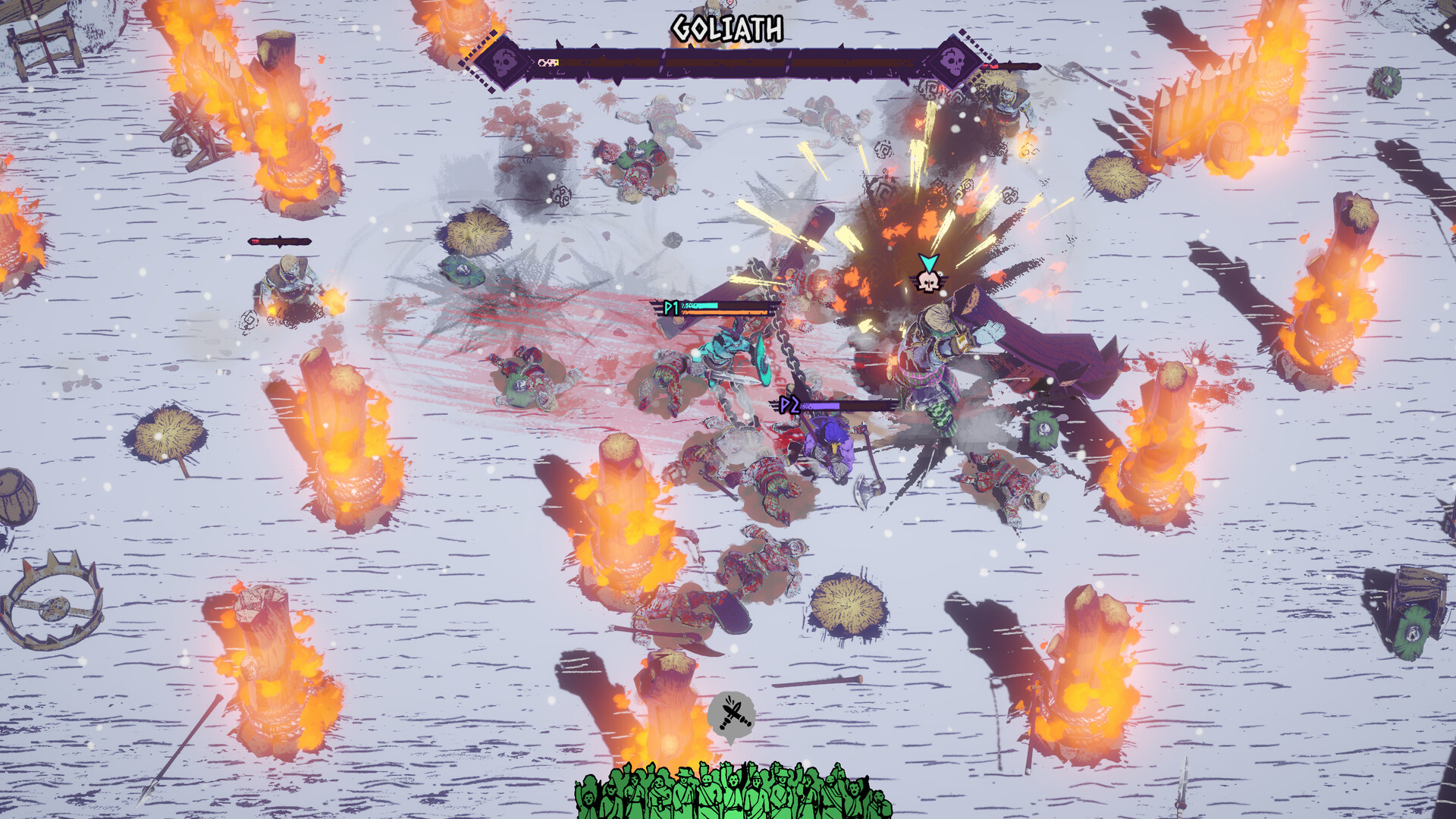
Official screenshot · Source: Steam store
That distinction is important: the four-player limit describes one session, not how many people are playing worldwide. Here is what you can confirm before buying or inviting your group.
| Question | Confirmed answer |
|---|---|
| How many players can play together? | 1–4 players total |
| Can you play solo? | Yes |
| Is online co-op supported? | Yes |
| Is local co-op supported? | Yes, through shared/split-screen co-op |
| Is Steam Remote Play Together listed? | Yes |
| What does local co-op require? | At least one gamepad |
| Is a current concurrent-player total verified here? | No |
| Is an all-time player peak verified here? | No |
These details come from the official Chained Beasts Steam listing, which describes Featherweight Games’ gladiator roguelike as a one-to-four-player experience.
Information checked against the supplied source snapshot dated October 31, 2026. Live population figures, review totals, and store features can change.
How Many People Can Play Chained Beasts Together?
The maximum Chained Beasts player count is four people in one session, including you. That means a full group consists of one player plus three friends—not a host plus four additional players.
You do not need a full team to get started. The official one-to-four-player description covers solo play, two-player co-op, three-player co-op, and a complete four-player group.
| Group size | Supported? | Practical reason to choose it |
|---|---|---|
| 1 player | Yes | Play without coordinating schedules |
| 2 players | Yes | Team up with one friend and simplify communication |
| 3 players | Yes | Start even when your fourth friend is unavailable |
| 4 players | Yes | Bring the largest supported group |
| 5 or more players | Outside the stated limit | Split into separate groups or rotate players |
Does the store description imply five players?
One passage in the store copy encourages players to gather four friends. Read in isolation, that wording could suggest five people.
However, the store’s summary and its main game description both explicitly identify the game as supporting 1–4 players. Use that stated range when planning your party. The looser promotional wording is not evidence of a five-player mode.
Do smaller groups miss the core experience?
Smaller groups still have official support. However, support for different party sizes does not establish that every group size has identical difficulty, enemy numbers, or chain arrangements.
The supplied material does not explain the exact scaling rules. Avoid assuming that two players face precisely half the enemies or that solo characters receive a specific damage bonus.
For scheduling purposes, the useful answer is simpler: you can start with the friends available rather than waiting for four people.
Online Co-op, Couch Co-op, and Controller Requirements
The Chained Beasts player count is only part of planning a session. You also need to know whether everyone will play on the same computer, connect online, or use Steam’s remote-sharing feature.
The Steam listing confirms online co-op, shared/split-screen co-op, and Remote Play Together. These are distinct ways to play, even though they all fall under the game’s stated four-player maximum.
| Play option | What the listing confirms | What to check before game night |
|---|---|---|
| Single-player | Solo play is supported | Your preferred controls and system requirements |
| Online co-op | Native online cooperative play is listed | How to invite and connect with your group |
| Local co-op | Shared/split-screen co-op is listed | Controller detection and player inputs |
| Remote Play Together | Steam’s shared-play feature is listed | Streaming quality and remote input setup |
| Cross-platform multiplayer | The feature badge appears on Steam | Which specific platform combinations are supported |
Local co-op needs at least one gamepad
The system requirements explicitly state that same-screen co-op requires at least one gamepad. The developers also recommend playing with a controller.
That does not mean every participant necessarily needs a controller. It also does not confirm that several people can share a single keyboard. The available material establishes the minimum requirement, not every possible input arrangement.
Before friends arrive:
- Connect the controllers you intend to use.
- Check that the game recognizes each player’s input.
- Confirm that everyone can join the local session.
- Test the screen layout before committing to a longer run.
Remote Play Together is not native online co-op
Remote Play Together lets a host stream a supported local multiplayer game to remote participants through Steam. Native online co-op instead uses the game’s own online multiplayer functionality.
Because Chained Beasts lists both, choose the option that suits your group rather than treating them as interchangeable. Test Remote Play Together early: streaming quality and input responsiveness can affect a fast-moving arena game.
The cross-platform badge also deserves care. It does not, by itself, confirm compatibility with every console or storefront. Check the supported combination before purchasing specifically to join someone on another platform.
Chained Beasts Player Count on Steam: What Is Verified?
If you want the live Chained Beasts player count, the supplied research does not contain a usable concurrent-player figure. The chart-page capture returned an access-check page rather than population statistics.
That means there is no supported basis here for quoting a current total, a 24-hour peak, an all-time record, or a monthly average.
| Metric | What it measures | Available in the supplied material? |
|---|---|---|
| Session capacity | Maximum people playing together in one session | Yes: 4 |
| Current concurrent players | People running the game on Steam at that moment | No verified figure |
| 24-hour peak | Highest simultaneous Steam population during that period | No verified figure |
| All-time peak | Highest recorded simultaneous Steam population | No verified figure |
| Average concurrent players | Average simultaneous population over a defined period | No verified figure |
| User review score | Sentiment among the reviews counted by Steam | Yes, in the captured store snapshot |
Review totals are not active-player totals
The captured Steam summary reports 994 reviews with an 83% positive rating, categorized as Very Positive. Those figures describe review activity and sentiment, not the number of people online.
You cannot reliably convert reviews into current players, sales, or matchmaking availability. Many owners never review a game, and reviews remain visible after someone stops playing.
Similarly, a recent update is evidence of an update—not proof of population growth. The store snapshot lists version 1.0.2 on October 27, 2026, but provides no accompanying player-count trend.
How to check population figures responsibly
When looking up a fresh Chained Beasts player count:
- Identify the metric. “Playing now” and “all-time peak” answer different questions.
- Check the timestamp. A live figure becomes outdated quickly.
- Confirm the scope. Steam concurrency should not be presented as an all-platform total.
- Compare similar periods. One quiet weekday reading is not directly comparable to a weekend peak.
- Separate concurrency from matchmaking. People running the game are not necessarily seeking public teammates.
For someone bringing an existing group, the session limit is usually more immediately useful than the global population. If you need strangers to fill your team, investigate the available player-finding options separately; the supplied material does not establish their activity.
Choosing Your Group Size and Preparing for a Run
A four-player maximum tells you who can join, but the chain mechanics explain why party size matters. Your teammates are not simply fighting alongside you: their movement can directly interfere with yours.
Player experience: The supplied pre-release video describes four-person sessions with several chain arrangements, including paired players, three linked teammates with one free player, and all four fighters connected in a line. It also describes players becoming tangled around arena pillars.
These observations help illustrate the multiplayer appeal, but they are not an exhaustive specification of every arrangement in the current build.
| Group setup | Likely coordination consideration | Useful habit |
|---|---|---|
| Solo | No human teammate to discuss decisions with | Learn combat timing and environmental threats |
| Two players | Both players need compatible movement plans | Agree on a direction before repositioning |
| Three players | Several priorities can compete during a fight | Call out the immediate target or escape route |
| Four players | More simultaneous decisions can create confusion | Use short, specific movement calls |
These are practical recommendations, not verified claims about difficulty scaling or which party size is strongest.
Coordinate movement before chasing enemies
When players are linked, separate pursuits can work against the team. One person moving toward an enemy may prevent another from escaping a hazard.
Use clear calls such as:
- “Move clockwise.”
- “Back away from the pillar.”
- “Stop pulling.”
- “Clear the nearby enemies first.”
Agreeing on a route is more useful than having everyone shout different destinations. The official description also presents chains as offensive tools, so coordinated positioning can create opportunities rather than merely prevent accidents.
Discuss injuries and upgrades
The official game description includes lasting wounds, healing potions with side effects, and character upgrades. Those systems make communication useful between battles as well as during them.
Player experience: The overview describes injuries affecting vision, movement, and weapon handling. It also describes teammates negotiating upgrade choices to support their different builds.
Tell your group when a new drawback changes what you can do reliably. A teammate with impaired vision may need clearer directions; someone struggling with movement may need the group to reposition more carefully.
Use the demo to answer personal questions
The captured Steam page lists a downloadable demo. If it remains available, it can help you assess combat feel, controller comfort, and performance before buying.
Check the demo’s own description before assuming it includes every multiplayer feature from the full game. For a planned group purchase, testing the basics is more useful than relying solely on another player’s enthusiasm.
Ultimately, choose your Chained Beasts player count around the people available. Four players accommodate the largest group, but two or three are officially supported, and solo play remains an option when schedules do not line up.
FAQ
What is the maximum Chained Beasts player count?
The maximum Chained Beasts player count is four players total, including you. The official description supports one to four players, so you can bring up to three friends into a full session.
Can you play Chained Beasts with two or three players?
Yes. Both two-player and three-player groups fall within the official supported range. You do not need four people to play co-op, although the supplied sources do not explain the exact difficulty-scaling rules for each group size.
Does Chained Beasts have local co-op?
Yes. Steam lists shared/split-screen co-op, alongside online co-op and Remote Play Together. Same-screen co-op requires at least one gamepad, and the developers recommend using a controller.
How many people are playing Chained Beasts right now?
A verified live concurrent-player total is not available in the supplied material. The four-player session limit and Steam review count do not answer that question. Look for a timestamped population figure that clearly identifies its platform and measurement period.
Related Guides
Chained Beasts Afflictions Guide: Potions vs Surgery
Chained Beasts afflictions can wreck a run. Learn potion risks, surgery trade-offs, and which injuries to carry into the next arena.
Chained Beasts gameplay: Combat and Survival Guide
Master Chained Beasts gameplay with practical tips for chain combat, co-op positioning, arena hazards, builds, and affliction management.
Chained Beasts guide: Co-op Arena Survival Tips
Master chains, afflictions, crowd favor, and co-op builds in this Chained Beasts guide for Carthage, Germania, and Rome.
Chained Beasts full release date: Oct 15, 2026
Chained Beasts full release date was October 15, 2026. Check price, co-op setup, the sale window, and the update roadmap.
Chained Beasts console: PS5 Co-op Gladiator Guide
Plan a Chained Beasts console run on PS5: chain co-op, arena tools, wounds, bosses, and tips before you gather a party.