Chained Beasts Split Screen Couch Co-Op Guide
See how Chained Beasts split screen couch co-op works for 1-4 players, including controllers, setup, and local party tips.
Chained Beasts split screen support is the difference between a chaotic couch session and four people squinting at one tiny gladiator. Featherweight Games built a 1–4 player co-op roguelike where you are literally tied to your friends, so the camera has to survive bad decisions as often as the fighters do. If you are checking Chained Beasts split screen details before game night, the store listing includes shared and split-screen co-op, and same-screen play calls for at least one gamepad.
The full game launched on October 15, 2026. Early Steam reviews sit at Very Positive, about 82% of 390 user reviews. That is a fresh sample, not a years-long verdict, but it is enough to plan a local night around what the game actually asks of a TV, a stack of controllers, and a group that will trip over its own chain.
What local multiplayer includes
Chained Beasts is a top-down gladiator roguelike from Featherweight Games, who developed and published it. You fight through arena days, take wounds, buy gear, learn skills, and push toward tougher bosses. Solo play exists. The pitch, though, is a hardcore party game: brutal hits mixed with slapstick when the group cannot agree on a direction.
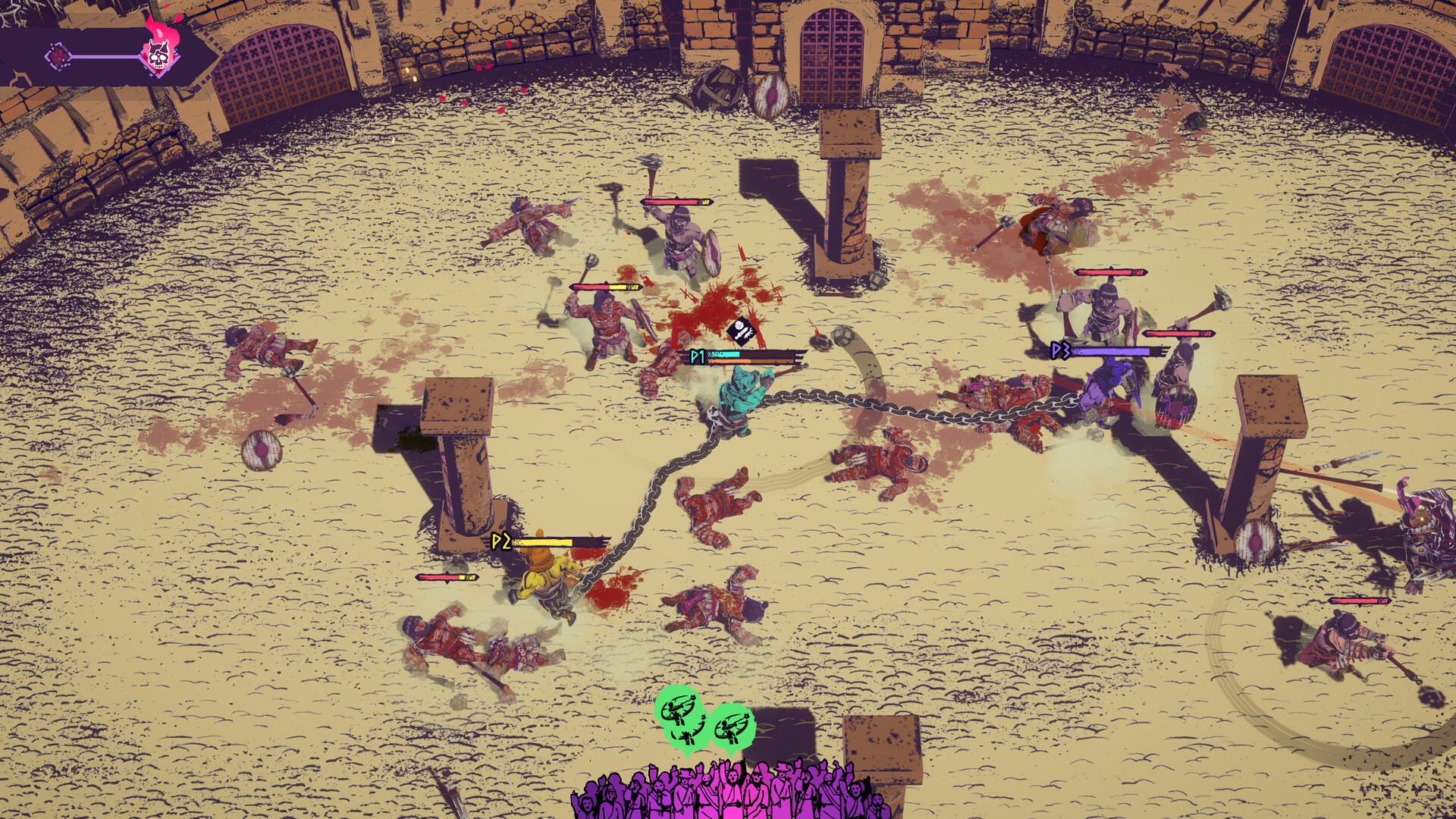
Official screenshot · Source: Steam store
On the Chained Beasts Steam page, local play is listed as both shared/split screen and shared/split screen co-op, alongside online co-op, cross-platform multiplayer, and Steam Remote Play Together. Tags from players also call out 4-player local and local co-op. The clearest player count on the store page is one to four, whether you are alone or filling the couch.
Public copy does not diagram the camera. It does not say whether four local players get a fixed four-way grid, a dynamic split, or a shared view that only divides when someone sprints off. Treat “shared/split screen” as Steam’s feature label, then judge the feel in the first fight. A demo is available if you want to test the TV before buying four copies of snacks and zero copies of patience.
| Way to play | Who it fits | What the listing supports | Practical limit |
|---|---|---|---|
| Solo | Learning bosses and builds | Single-player | One screen, no chain partners |
| Couch, shared or split | People in the same room | Shared/split screen co-op, up to 4 | At least one gamepad for same-screen co-op |
| Online co-op | Friends on their own machines | Online co-op and cross-platform multiplayer | Still inside the 1–4 player design |
| Remote Play Together | A host streaming to remote friends | Steam Remote Play Together | Depends on the host PC and upload quality |
A community thread title asks whether four players can be split as two and two across two PCs. That layout is a reasonable wish, but the scraped store text does not confirm mixed local-plus-online seating. Plan on either one machine for the whole couch or a normal online session, and test any hybrid before you promise it.
Set up Chained Beasts split screen for a couch night
Chained Beasts split screen nights fail for boring reasons: one controller, a dying battery, or a TV so small that four health bars eat the arena. The system notes are blunt. Windows and macOS both say at least one gamepad is required for same-screen co-op. The developers also recommend a controller in general, and the page lists Xbox and PlayStation controllers.
One pad meets the written minimum. It is a poor plan for four people. This is a real-time brawler where you throw weapons, shove foes into hazards, and get yanked by a chain. Assign one controller per local player. Four Xbox pads, four DualSense or DualShock pads, or a mix should be the default kit if both families are listed as supported on your PC.
Use this checklist before the first run, not after someone is already tangled on a pillar.
| Step | Do this | Why it matters |
|---|---|---|
| 1 | Put the host PC or Mac on a TV everyone can see | Top-down fights get cramped once the view splits or the chain stretches |
| 2 | Plug in one pad per local player and test each | Same-screen co-op requires a gamepad; extras prevent mid-fight swaps |
| 3 | Start with two players, then add a third and fourth | You learn the camera before the party is at max chaos |
| 4 | Pick beasts with readable silhouettes | Eight beasts, plus variants and cosmetics, can look similar in a small pane |
| 5 | Agree who calls direction during pulls | Official copy warns that poor sync wraps you around pillars |
| 6 | Pause before every heal | Afflictions are the price of recovery and can wreck a shared view |
Keyboard and mouse are not described as the local-co-op solution. If someone wants mouse aim, try it in the demo or a private lobby first. Do not discover an input limit after the boss door opens.
Remote Play Together is the fallback when a friend cannot travel but you still want a local-style session. The host runs the game and Steam streams it. That is not the same as native online co-op, and a weak upload will feel worse than a slightly small split pane in the same room. For a pure couch question asked by players who do not care about online or solo, native same-screen play is the mode to judge.
How the chain fights the camera
The fantasy is simple and mean. You and your friends are chained, and the chain is both a weapon and a handicap. Marketing describes hurling urns, throwing enemies into urns, charging people into spikes, and dumping them toward a snake pit. Ranged throws work only if you still have another weapon when the first one leaves your hand.
Coordination is the local-multiplayer skill. Move together and you can trip enemies. Sprint three different ways and the group becomes a knot. A player on the community hub asked whether the chains have real physics and whether friends can snag poles and tie each other up. The studio’s own description already promises tangles around a pillar “or worse,” so couch groups should expect physical comedy, not a cosmetic rope.
That is why Chained Beasts split screen matters more here than in a typical top-down hack-and-slash. A shared camera keeps the chain readable and the party on one stage, but it punishes anyone who needs personal space. A split view lets each beast track their own target, but it can hide the slack in the chain until someone is already stuck. Neither layout is free. Call out when you are about to dash. If the chain goes tight, stop sprinting instead of dragging a wounded friend through spikes.
Studio history explains the obsession. Co-director Tim Kaldor has described the project as the team’s first game idea, started about twelve years before launch, born from a 48-hour jam called Enterchained and a chained-prisoner image in the film Gladiator. They shelved the expansion after roughly six months, then later leaned harder into chain chaos and injuries with a full group. Co-director Dylan Bevis has credited beta and demo players with smoothing confusing co-op interactions. Local play is not a mode bolted on at the end. It is the joke and the difficulty.
| Local pressure | What the game pushes you to do | Couch fix |
|---|---|---|
| Chain tension | Stay close enough to fight as a unit | Pick a leader and move on their count |
| Arena hazards | Use spikes, pits, and props as weapons | Do not body-block the friend who is lining up a throw |
| Dropped weapons | Throw only when you have a backup | Call “weapon down” so someone kites while you recover it |
| Boss focus | Survive stacked advantages | Split adds and bosses only after you know the chain length |
| Crowd and gold | Play for favor, cash, and gear | Let one person be the shop talker so the run does not stall |
Runs are structured as a climb, not a single match. Launch messaging describes nine grinding battles across three acts, bosses along the way, and a final encounter, plus ten difficulty levels that get nastier. Expect a session to outlast a party-game round. Budget an evening, or plan a clean pause between acts.
Afflictions that hit a shared TV harder
Healing is a deal with a bad doctor. Between rounds you can recover, but you accept an affliction. The studio says there are more than 70 of them, physical and mental, on top of more than 70 skills and 40-plus items. Eight beasts can be unlocked, with variants that change stats, abilities, and cosmetics.
Some launch examples are funny until they meet a couch camera. Annoying makes allies prone to attacking you if you stand too close, which is a cruel joke in a game that chains you together. Impulsive forces a new skill on every second level and a purchase at every shop. Infatuated drags the camera toward one ally and grants extra damage when that ally is looking at you. A camera-stealing debuff is not a footnote for local play. On one television it can hide the player who actually needs to dodge.
Player experience lines up with that design. One early review called the risk-reward loop the highlight: small problems such as colorblindness or dropping a weapon, versus run-threatening ones such as lost arms or constantly being on fire. The reviewer liked that you choose the gamble. Grind for another level and accept a blind eye, or heal to full and maybe lose a toe that makes sprints trip. Another player stacked Far-Sighted and Near-Sighted, joked that only a donut of vision remained, and nicknamed it bagel-vision. They still won a round as the useless fighter. That is comedy on a couch and misery if nobody warned you.
Not every community note is praise. A negative review enjoyed the game with friends but marked it down because some unlock challenges credit only the player who lands the requirement, using a rhino outfit tied to getting the killing blow on the first boss as the example. The reviewer said a full group might repeat the run so each person can take the credit. A developer replied on that review. Treat the credit rule as a live complaint from launch week, not as a promise that it is already changed.
| Affliction style | Example from official or player reports | Local-party impact |
|---|---|---|
| Friendly friction | Annoying: nearby allies may attack you | Terrible when the chain forces proximity |
| Camera control | Infatuated: view follows one ally | Can hide other players on a shared TV |
| Forced spending | Impulsive: extra skill locks and shop buys | Slows turns if the group debates every purchase |
| Vision | Player-reported far- and near-sight stacking | One person may need a caller for off-screen threats |
| Severe body harm | Player-reported lost limbs or constant fire | Decide as a group before you “just heal” |
For couch rules, say the cost out loud before anyone confirms a heal. If the option mentions eyes, camera, or allies attacking, it is a group problem even when it is applied to one beast.
Hardware, price, and who should host
Minimum PC specs are modest for a 2026 action game: 64-bit Windows 10, an Intel Core i5-5257U or AMD Ryzen 3 1200 class CPU, 8 GB of RAM, and a GeForce GTX 1050 or Radeon RX 460 class GPU. Mac minimums are macOS 11, an Apple M1 or Intel i7-8850H, 8 GB of RAM, and Apple M1 or Radeon Pro 560X graphics. The same gamepad note appears on both. Recommended PC details beyond “64-bit processor and OS” were thin on the store listing used here, so do not assume a published ultra spec.
Steam Deck compatibility was listed as Unknown in that same window. Do not sell the living room on a four-player handheld session until Valve’s status, or your own test, says otherwise. A docked Deck might be fine later. It is not a documented couch guarantee today.
| Platform note | Listed minimum | Local co-op extra |
|---|---|---|
| Windows | Win 10, 8 GB RAM, GTX 1050 / RX 460 class | Gamepad required for same-screen co-op |
| macOS | macOS 11, 8 GB RAM, M1 or Radeon Pro 560X | Same gamepad requirement |
| Steam Deck | Compatibility Unknown | Test before you depend on it |
| Controllers | Xbox and PlayStation pads listed | One per player is the sane couch setup |
Language support helps mixed households. English has full audio plus interface and subtitles. French, Italian, German, Japanese, Korean, Brazilian Portuguese, Simplified Chinese, Latin American Spanish, Traditional Chinese, Russian, and Turkish are listed with interface and subtitles, not full audio. Subtitles matter when four people talk over the arena.
The introductory discount at launch was 35% off, $19.99 down to $12.99, dated to end October 29, 2026. Bundles with Gang Beasts, Cult of the Lamb, and LORT were also on the store, at extra bundle savings that can move by region. There are 60 Steam achievements, Steam Cloud, and Family Sharing. Blood sprays that stay on the floor are the stated mature-content note. It is violent slapstick, not a story-heavy drama, but it is still a bloody arena.
Post-launch plans, written just before release, pointed to a December 1.1 update with a new arena, boss, weapon, and enemies, then a hoped-for PvP mode in the first quarter of 2027 plus more skills and afflictions. Later ideas included more acts, beasts, and cosmetics. Those are studio intentions from the roadmap, not features you can select on day three. Player experience on variety is similarly early: one reviewer felt 10–15 strong solo hours, more with friends, then repeating shop items and afflictions, with higher difficulties mostly adding tougher, denser fights rather than a new game. Another thread asked for automated cross-platform matchmaking. If your group is already on the couch, matchmaking is irrelevant. If you are often short one player, it is a real wishlist item, not a current button.
Chained Beasts split screen is worth setting up when your friends will laugh at a bad pull and still reset the fight. It is a weaker fit if you want a quiet, perfectly readable four-player HUD with no friendly accidents. Bring pads, start at two players, read every affliction, and let the chain tell you when the formation is wrong.
FAQ
Does Chained Beasts split screen allow four players on one TV?
Yes, within the game’s 1–4 player co-op. Steam lists shared/split screen co-op and 4-player local tags, and launch posts tell you to play at home with couch co-op. The page does not publish the exact pane layout, so test two players before you commit the whole group.
Can we play Chained Beasts split screen with one controller?
Same-screen co-op requires at least one gamepad, but that minimum will not comfortably cover a full party. Bring one Xbox or PlayStation controller per local player. The developers recommend a controller even before you add friends.
Is couch play different from online co-op?
They are separate listings. Couch play uses shared or split screen on one machine. Online co-op and cross-platform multiplayer are for players joining over the network. Remote Play Together is a third option, where the host streams a session. A community question about two local players on each of two PCs is not answered by the store copy, so confirm that mix yourself.
What should a local group watch out for besides the camera?
The chain and the afflictions. Poor movement can tangle you on arena geometry. Heals can add friendly-fire behavior, forced purchases, or camera effects such as Infatuated. Player reports also describe vision curses and severe injuries. Read the trade before you take it, and decide as a group.
Related Guides
Chained Beasts coop: Chains, Builds, and Team Tips
Chained Beasts coop explained: chain layouts, afflictions, shared shops, punch builds, and team tips from early player runs.
Chained Beasts couch co op: local play guide
Player-tested look at Chained Beasts couch co op: chains, crowd scores, shared gold, afflictions, and local multiplayer tips.
Chained Beasts crossplay: Who Can Play Together
How Chained Beasts crossplay works for 1-4 player co-op, which PC platforms connect on Steam, and how couch play fits in.
Chained Beasts full release date: Oct 15, 2026
Chained Beasts full release date was October 15, 2026. Check price, co-op setup, the sale window, and the update roadmap.
Chained Beasts console: PS5 Co-op Gladiator Guide
Plan a Chained Beasts console run on PS5: chain co-op, arena tools, wounds, bosses, and tips before you gather a party.